## Flowchart: Problem Decomposition for Integer Sequence Pairs
### Overview
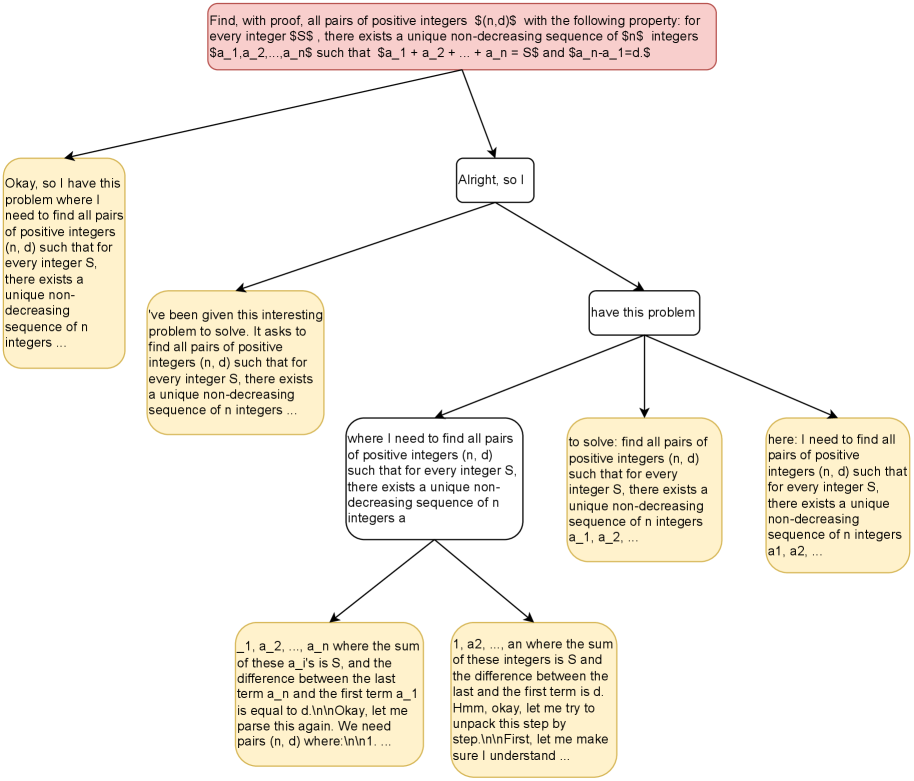
The image depicts a flowchart representing a recursive or iterative problem-solving process for finding pairs of positive integers (n, d) that satisfy specific mathematical conditions. The central node contains the core problem statement, with branching paths leading to progressively detailed explanations, restatements, and component breakdowns. The flowchart appears to map out a logical decomposition of a complex mathematical problem, likely related to number theory or combinatorial sequences.
### Components/Axes
- **Central Node**: Contains the primary problem statement in LaTeX-style mathematical notation
- **Branching Arrows**: Connect the central node to 6 peripheral nodes containing:
1. Simplified problem restatement
2. Problem clarification
3. Component breakdown (sequence definition)
4. Problem restatement with variables
5. Component breakdown (sum/difference conditions)
6. Problem restatement with sequence notation
### Detailed Analysis
#### Central Node Text
"Find, with proof, all pairs (n,d) with the following property: for every integer S$, there exists a unique non-decreasing sequence of n$ integers a_1,a_2,...,a_n$ such that a_1 + a_2 + ... + a_n = S$ and a_n - a_1 = d$"
#### Peripheral Nodes
1. **Simplified Restatement**:
"Okay, so I have this problem where I need to find all pairs of positive integers (n, d) such that for every integer S, there exists a unique non-decreasing sequence of n integers ..."
2. **Problem Clarification**:
"Alright, so I have this problem. It asks to find all pairs of positive integers (n, d) such that for every integer S, there exists a unique non-decreasing sequence of n integers ..."
3. **Component Breakdown (Sequence Definition)**:
"where I need to find all pairs of positive integers (n, d) such that for every integer S, there exists a unique non-decreasing sequence of n integers a_1, a_2, ..."
4. **Variable-Restated Problem**:
"to solve: find all pairs of positive integers (n, d) such that for every integer S, there exists a unique non-decreasing sequence of n integers a_1, a_2, ..."
5. **Sum/Difference Conditions**:
"1, a_2, ..., a_n where the sum of these a_i's is S, and the difference between the last term a_n and the first term a_1 is equal to d"
6. **Confusion Node**:
"Hmm, okay, let me try to unpack this step by step. First, let me make sure I understand ..."
### Key Observations
- The problem requires finding integer pairs (n,d) that work universally for all integers S
- The solution must guarantee both existence and uniqueness of sequences
- The sequences must be non-decreasing and satisfy two constraints:
1. Sum equals S
2. Difference between maximum and minimum terms equals d
- Multiple nodes show recursive restatements, suggesting iterative refinement of understanding
- One node explicitly shows confusion about parsing the problem, indicating potential complexity
### Interpretation
This flowchart represents a systematic approach to solving a non-trivial mathematical problem, likely related to:
1. **Integer Partition Theory**: Finding ways to represent integers as sums of sequences
2. **Combinatorial Design**: Creating sequences with specific structural properties
3. **Algorithmic Proof Construction**: Developing a method to verify the existence and uniqueness of solutions
The recursive nature of the flowchart suggests the problem may require:
- Mathematical induction
- Recursive sequence construction
- Case analysis based on n and d values
The presence of confusion in one node indicates that:
- The problem may have non-obvious constraints
- The solution space might be complex or counterintuitive
- Multiple verification steps are needed to ensure correctness
The use of LaTeX-style notation and mathematical rigor in the problem statement implies this is likely:
- A theoretical computer science problem
- A mathematical competition question
- A research-level number theory challenge
The flowchart's structure demonstrates an effective problem-solving strategy of:
1. Restating the problem in multiple ways
2. Breaking down complex conditions
3. Verifying understanding through iterative explanation
4. Identifying knowledge gaps through self-questioning