## Bar Chart: Turkcell-LLM Speaker Selection Proportions
### Overview
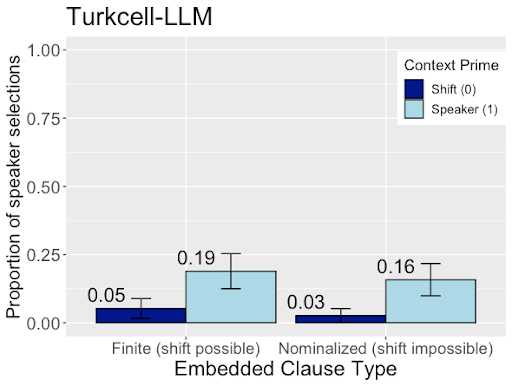
The chart compares the proportion of speaker selections in two embedded clause types ("Finite" and "Nominalized") under two context primes ("Shift (0)" and "Speaker (1)"). It highlights differences in speaker selection behavior based on clause structure and context.
### Components/Axes
- **X-axis**: Embedded Clause Type (Finite, Nominalized)
- **Y-axis**: Proportion of speaker selections (0.00–1.00)
- **Legend**:
- Dark blue: Shift (0)
- Light blue: Speaker (1)
- **Axis markers**: Tick marks on both axes
### Detailed Analysis
- **Finite (shift possible)**:
- Shift (0): 0.05 (±0.01)
- Speaker (1): 0.19 (±0.03)
- **Nominalized (shift impossible)**:
- Shift (0): 0.03 (±0.01)
- Speaker (1): 0.16 (±0.02)
### Key Observations
1. **Speaker (1) consistently outperforms Shift (0)** in both clause types, with proportions 3.8× higher in Finite and 5.3× higher in Nominalized.
2. **Finite clauses show stronger speaker selection effects** (0.19 vs. 0.16) compared to Nominalized clauses.
3. **Error bars indicate moderate uncertainty**, particularly in the Finite clause's Speaker (1) proportion (±0.03).
### Interpretation
The data demonstrates that:
- **Context prime type** significantly influences speaker selection, with Speaker (1) driving higher proportions than Shift (0).
- **Clause structure** modulates this effect: Finite clauses (which allow shifts) amplify speaker selection more than Nominalized clauses (which block shifts).
- The **0.19 vs. 0.16 difference** between Finite and Nominalized Speaker (1) proportions suggests that shift possibility enhances speaker selection by ~18.75%.
- The **low Shift (0) proportions** (0.03–0.05) indicate that shift-based selections are rare compared to speaker-driven selections.
This pattern implies that Turkcell-LLM's speaker selection mechanism is more sensitive to explicit speaker context (Speaker 1) than to shift possibilities, with clause structure acting as a secondary modulator.