## Flow Diagram: LS Types and Members
### Overview
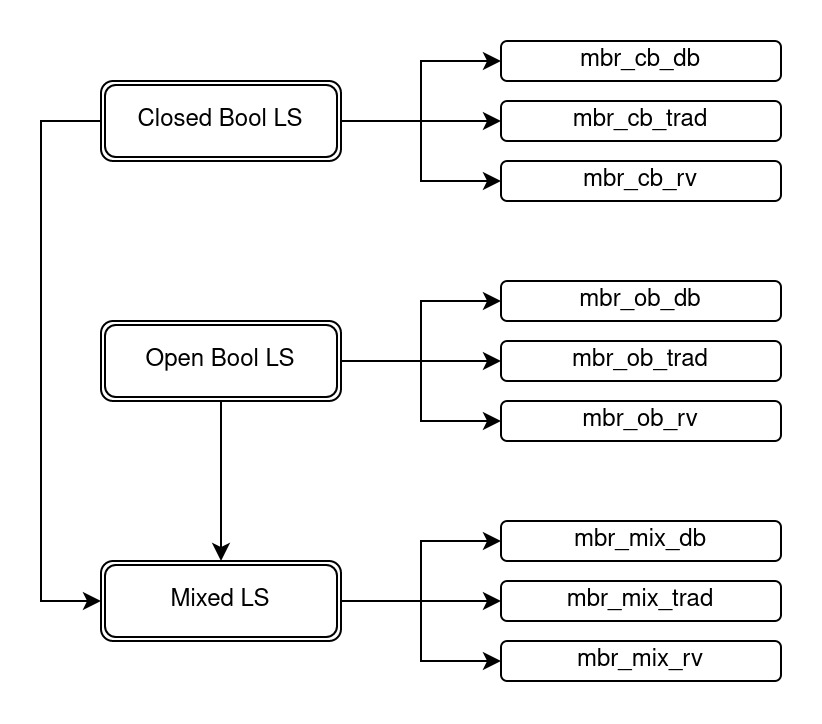
The image is a flow diagram illustrating the relationship between different types of "LS" (likely List or Logic Structure) and their members. The diagram shows three types of LS: Closed Bool LS, Open Bool LS, and Mixed LS. Each LS type is connected to three members, denoted as `_db`, `_trad`, and `_rv`. The Open Bool LS also connects to the Mixed LS.
### Components/Axes
* **Nodes:** The diagram consists of rectangular nodes with rounded corners. Each node contains a text label.
* **Arrows:** Arrows indicate the flow or relationship between the nodes.
* **LS Types (Left Column):**
* Closed Bool LS (top)
* Open Bool LS (middle)
* Mixed LS (bottom)
* **Members (Right Column):** Each LS type is connected to three members. The naming convention for the members is `mbr_[LS type abbreviation]_[suffix]`, where the suffix is either `db`, `trad`, or `rv`.
* For Closed Bool LS: `mbr_cb_db`, `mbr_cb_trad`, `mbr_cb_rv`
* For Open Bool LS: `mbr_ob_db`, `mbr_ob_trad`, `mbr_ob_rv`
* For Mixed LS: `mbr_mix_db`, `mbr_mix_trad`, `mbr_mix_rv`
### Detailed Analysis or Content Details
1. **Closed Bool LS:** This node is located at the top-left of the diagram. It has three outgoing arrows, each pointing to one of its members:
* `mbr_cb_db` (top-right)
* `mbr_cb_trad` (middle-right, top group)
* `mbr_cb_rv` (bottom-right, top group)
2. **Open Bool LS:** This node is located in the middle-left of the diagram. It has four outgoing arrows: three pointing to its members and one pointing to the Mixed LS node.
* `mbr_ob_db` (top-right, middle group)
* `mbr_ob_trad` (middle-right, middle group)
* `mbr_ob_rv` (bottom-right, middle group)
* Mixed LS (bottom-left)
3. **Mixed LS:** This node is located at the bottom-left of the diagram. It has three outgoing arrows, each pointing to one of its members:
* `mbr_mix_db` (top-right, bottom group)
* `mbr_mix_trad` (middle-right, bottom group)
* `mbr_mix_rv` (bottom-right, bottom group)
### Key Observations
* Both Closed Bool LS and Open Bool LS have three members each, with similar naming conventions.
* Open Bool LS has a direct relationship with Mixed LS.
* The suffixes `db`, `trad`, and `rv` are used consistently across all member types.
### Interpretation
The diagram illustrates a hierarchical relationship between different types of Logic Structures (LS) and their members. The "Open Bool LS" appears to influence or contribute to the "Mixed LS," suggesting a potential flow or transformation of data or logic from the "Open Bool LS" to the "Mixed LS." The consistent naming convention for the members (`_db`, `_trad`, `_rv`) suggests that these suffixes represent distinct categories or properties associated with each LS type. The diagram could represent a data processing pipeline, a class inheritance structure, or a logical decision tree.