## Flowchart: Logical System Classification and Sub-Component Breakdown
### Overview
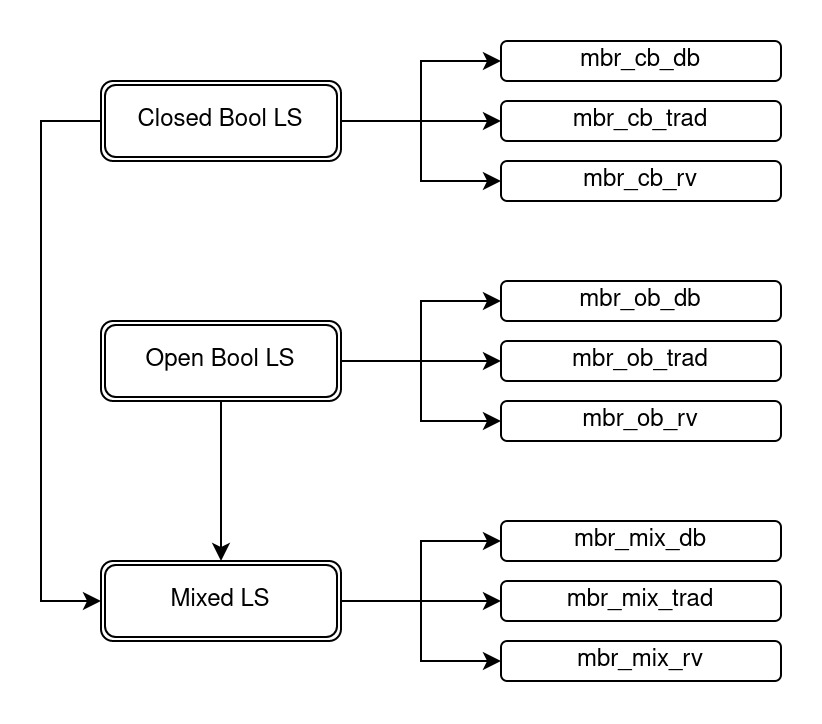
The diagram illustrates a hierarchical classification system for logical states (LS) with three primary categories: **Closed Bool LS**, **Open Bool LS**, and **Mixed LS**. Each category branches into three sub-components, suggesting a structured decomposition or workflow. Arrows indicate directional relationships between components.
### Components/Axes
- **Main Nodes**:
- **Closed Bool LS** (top)
- **Open Bool LS** (middle)
- **Mixed LS** (bottom)
- **Sub-Components**:
- **Closed Bool LS** → `mbr_cb_db`, `mbr_cb_trad`, `mbr_cb_rv`
- **Open Bool LS** → `mbr_ob_db`, `mbr_ob_trad`, `mbr_ob_rv`
- **Mixed LS** → `mbr_mix_db`, `mbr_mix_trad`, `mbr_mix_rv`
- **Flow Direction**:
- Vertical hierarchy (Closed → Open → Mixed)
- Horizontal branching to sub-components (rightward arrows)
### Detailed Analysis
- **Closed Bool LS**:
- Sub-components:
- `mbr_cb_db` (likely "database" or "data-based")
- `mbr_cb_trad` (possibly "traditional" or "traditional-based")
- `mbr_cb_rv` (potentially "revision" or "revision-based")
- **Open Bool LS**:
- Sub-components mirror the structure of Closed Bool LS but with "ob" (open) prefix:
- `mbr_ob_db`, `mbr_ob_trad`, `mbr_ob_rv`
- **Mixed LS**:
- Sub-components combine "mix" prefix:
- `mbr_mix_db`, `mbr_mix_trad`, `mbr_mix_rv`
- **Relationships**:
- Closed Bool LS directly feeds into Open Bool LS.
- Open Bool LS transitions to Mixed LS, which then branches into its sub-components.
### Key Observations
1. **Hierarchical Structure**: The system progresses from Closed to Open to Mixed states, with each level retaining a three-sub-component pattern.
2. **Nomenclature Consistency**: Sub-components follow a naming convention (`mbr_<state>_<attribute>`), where `<state>` is `cb` (closed), `ob` (open), or `mix` (mixed), and `<attribute>` is `db` (database), `trad` (traditional), or `rv` (revision).
3. **Flow Logic**: The downward arrow from Open Bool LS to Mixed LS implies a transformation or combination of states, while horizontal arrows suggest parallel sub-component analysis.
### Interpretation
This diagram likely represents a technical workflow or classification system for managing logical states in a computational or data-processing context. The progression from Closed to Open to Mixed states suggests a dynamic system where constraints evolve (e.g., from rigid to flexible configurations). The consistent sub-component structure across all states implies standardized attributes (database, traditional, revision) that are adapted to each logical state. The absence of numerical data or uncertainty markers indicates this is a conceptual or architectural diagram rather than a statistical representation. The use of "mbr" (possibly "member" or "metadata") in sub-component labels hints at metadata management or member-based categorization within each state.