## Hierarchical Diagram: System/Entity Relationship Structure
### Overview
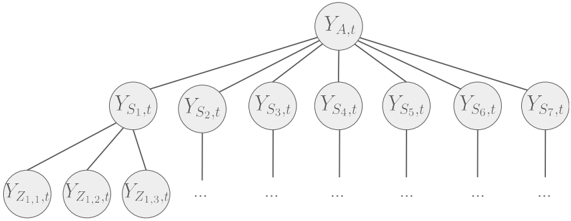
The image depicts a hierarchical tree structure with nodes labeled using mathematical notation. The diagram shows a root node branching into multiple sub-nodes, with one sub-node further branching into additional nodes. All labels follow the format `Y_[subscript]_[t]` or `Y_Z[subscript]_[t]`, suggesting temporal or categorical dimensions.
### Components/Axes
- **Root Node**: `Y_A,t` (central top node)
- **First-Level Sub-nodes**:
- `Y_S1,t` to `Y_S7,t` (7 nodes branching directly from root)
- **Second-Level Sub-nodes**:
- Only `Y_S1,t` has children: `Y_Z1,1,t`, `Y_Z1,2,t`, `Y_Z1,3,t`
- **No explicit axes, scales, or legends** present in the diagram.
### Detailed Analysis
- **Root Node (`Y_A,t`)**:
- Positioned at the top center, acting as the primary source or aggregate entity.
- Connects to 7 first-level sub-nodes (`Y_S1,t` to `Y_S7,t`).
- **First-Level Sub-nodes (`Y_S1,t` to `Y_S7,t`)**:
- All directly connected to `Y_A,t` via straight lines.
- `Y_S1,t` is the only node with further branching.
- Other `Y_S` nodes (`Y_S2,t` to `Y_S7,t`) are terminal (no children).
- **Second-Level Sub-nodes (`Y_Z1,1,t` to `Y_Z1,3,t`)**:
- Descendants of `Y_S1,t` only.
- Arranged in a linear chain beneath `Y_S1,t`.
- No additional branching beyond this level.
### Key Observations
1. **Asymmetrical Branching**:
- Root node has 7 children, but only one (`Y_S1,t`) has further descendants.
- All other first-level nodes (`Y_S2,t` to `Y_S7,t`) are leaf nodes.
2. **Naming Convention**:
- Subscripts suggest categorical or dimensional relationships:
- `S1-S7`: Likely distinct categories or groups.
- `Z1,1-Z1,3`: Subcategories or nested dimensions under `S1`.
3. **Temporal Element**:
- The subscript `[t]` on all nodes implies a time-dependent or dynamic system.
### Interpretation
This diagram likely represents:
1. **A decision tree** where `Y_A,t` is the root decision, `Y_S1,t` to `Y_S7,t` are primary outcomes, and `Y_Z1,1,t` to `Y_Z1,3,t` are sub-outcomes of `S1`.
2. **An organizational structure** with `Y_A,t` as a top-level entity, `S1-S7` as departments, and `Z1,1-Z1,3` as sub-teams under `S1`.
3. **A data flow architecture** where `Y_A,t` is a source, `S1-S7` are processing stages, and `Z1,1-Z1,3` are sub-processes within `S1`.
The absence of children for `Y_S2,t` to `Y_S7,t` suggests these categories are terminal or lack further subdivision in this model. The linear arrangement of `Z1,1-Z1,3` under `S1` implies a sequential or ordered relationship within that subcategory.