## Chart/Diagram Type: Math Problem with Graph
### Overview
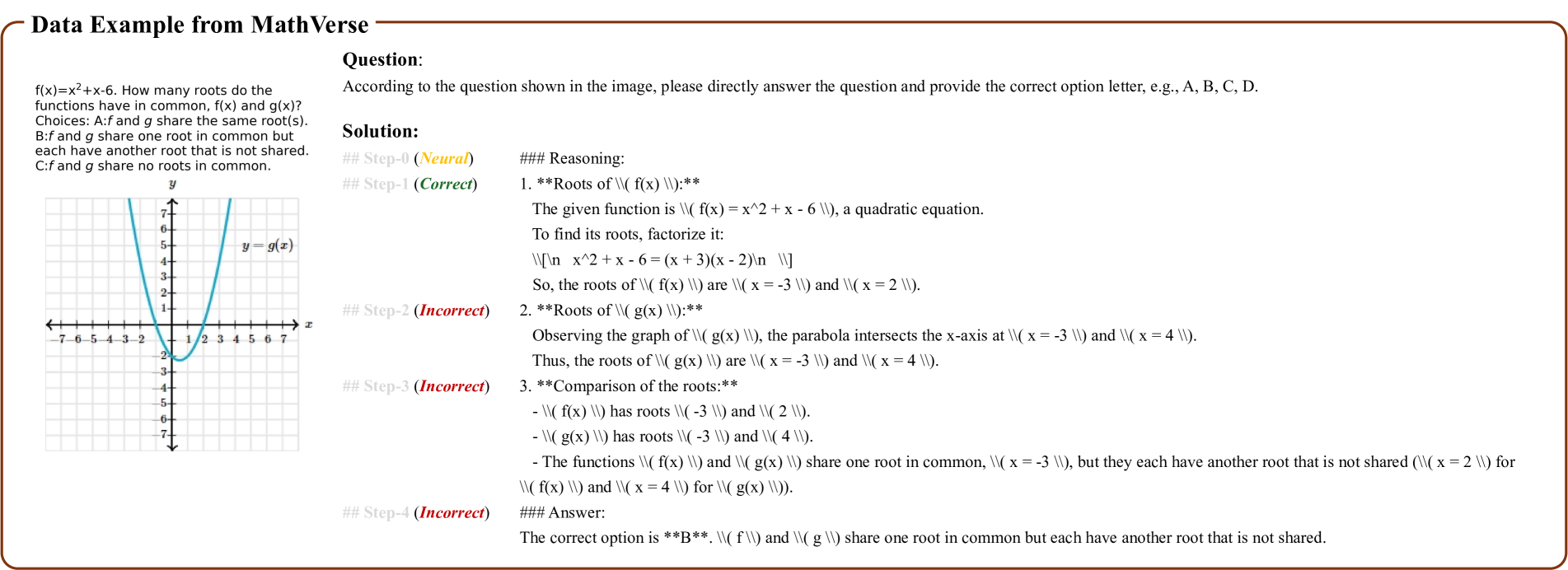
The image presents a math problem involving two functions, f(x) and g(x). It asks how many roots the functions have in common. The image includes the equation for f(x), a graph of g(x), and a step-by-step solution to the problem.
### Components/Axes
* **Title:** Data Example from MathVerse
* **Problem Statement:**
* f(x) = x² + x - 6. How many roots do the functions have in common, f(x) and g(x)?
* Choices: A: f and g share the same root(s). B: f and g share one root in common but each have another root that is not shared. C: f and g share no roots in common.
* **Graph:**
* Axes: x-axis and y-axis
* x-axis: Ranges from -7 to 7, with integer markings.
* y-axis: Ranges from -7 to 7, with integer markings.
* Curve: A parabola representing g(x), labeled as "y = g(x)". The parabola intersects the x-axis at x = -3 and x = 4. The vertex of the parabola appears to be around (0.5, -2.25).
* **Solution:**
* Step-by-step reasoning to find the roots of f(x) and g(x) and compare them.
* Final answer indicating that f(x) and g(x) share one root in common but each have another root that is not shared.
### Detailed Analysis or ### Content Details
* **Function f(x):** f(x) = x² + x - 6
* **Roots of f(x):** The solution shows that f(x) can be factored into (x + 3)(x - 2), so the roots are x = -3 and x = 2.
* **Graph of g(x):** The parabola intersects the x-axis at x = -3 and x = 4. Therefore, the roots of g(x) are x = -3 and x = 4.
* **Comparison:** Both functions share the root x = -3. f(x) has a root at x = 2, while g(x) has a root at x = 4.
* **Solution Steps:**
* Step-0 (Neural)
* Step-1 (Correct)
* Step-2 (Incorrect)
* Step-3 (Incorrect)
* Step-4 (Incorrect)
* **Answer:** The correct option is B. f and g share one root in common but each have another root that is not shared.
### Key Observations
* The graph of g(x) is a parabola opening upwards.
* The roots of f(x) are found algebraically, while the roots of g(x) are determined from the graph.
* The solution correctly identifies the shared root and the unique roots for each function.
### Interpretation
The problem demonstrates how to find the roots of a quadratic function algebraically and graphically. By comparing the roots of f(x) and g(x), the solution determines the number of common roots and identifies the correct answer choice. The step-by-step reasoning provides a clear explanation of the solution process. The "incorrect" labels on steps 2-4 suggest that these steps might represent common errors or alternative approaches that do not lead to the correct answer.