\n
## Mathematical Problem & Solution: Roots of Quadratic Functions
### Overview
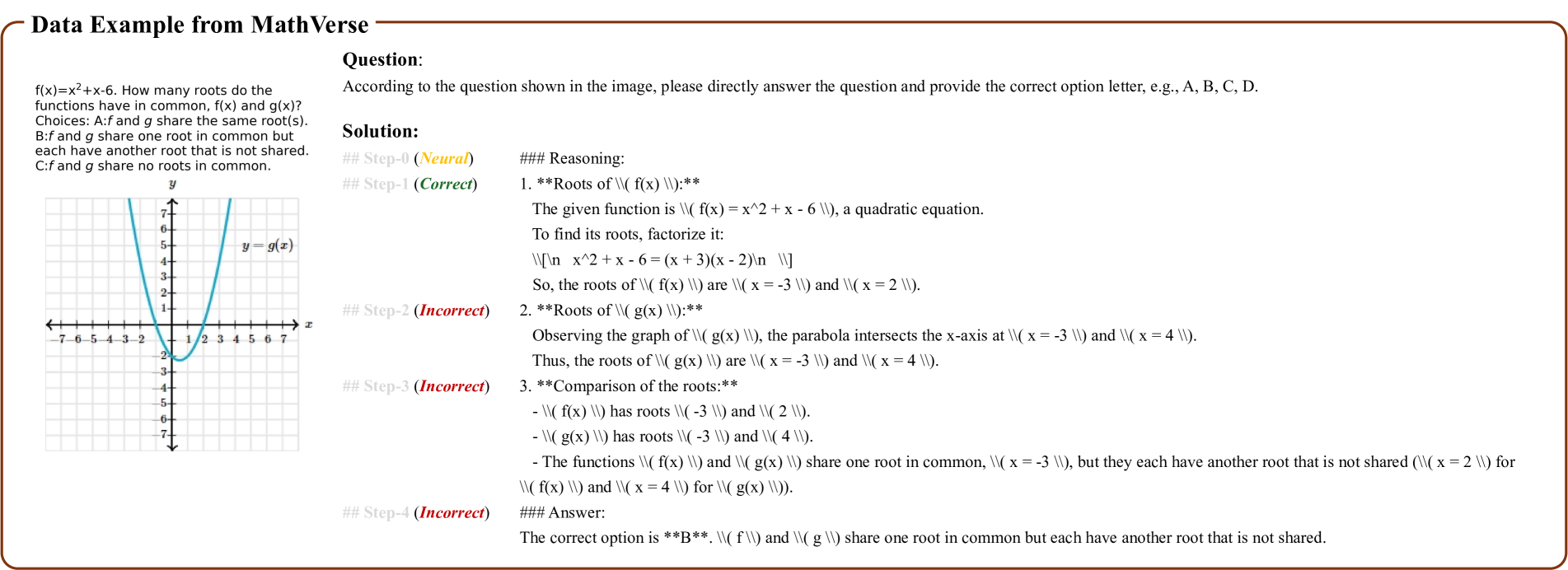
The image presents a mathematical problem involving finding the common roots of two quadratic functions, f(x) and g(x). It includes a graph of f(x), the question, a step-by-step solution with reasoning, and multiple-choice answers. The solution attempts to find the roots of each function and then compare them. The steps are marked as "Correct" or "Incorrect" with a neural network symbol next to the "Neural" step.
### Components/Axes
* **Graph:** A Cartesian coordinate system with the x-axis ranging from -7 to 7 and the y-axis ranging from -5 to 7. The function f(x) = x² - x - 6 is plotted as a parabola. The parabola is labeled "y = f(x)".
* **Question:** "According to the question shown in the image, please directly answer the question and provide the correct option letter, e.g., A, B, C, D."
* **Problem Statement:** "f(x)=x²-x-6. How many roots do the functions have in common, f(x) and g(x)?"
* **Choices:**
* A: f and g share the same roots.
* B: f and g share one root in common but each have another root that is not shared.
* C: f and g share no roots in common.
* **Solution Steps:** Numbered from 0 to 4, each with a "Correct" or "Incorrect" label.
* **Reasoning:** Detailed explanations for each step.
### Detailed Analysis or Content Details
**1. Graph Analysis:**
The parabola y = f(x) = x² - x - 6 intersects the x-axis at approximately x = -2 and x = 3.
**2. Problem Statement:**
The problem asks for the number of common roots between f(x) = x² - x - 6 and g(x) (which is not explicitly defined, but implied to be a different quadratic function).
**3. Solution Step 0 (Neural):**
This step is marked as "Neural" and "Correct". It doesn't contain any mathematical content.
**4. Solution Step 1 (Correct):**
* **Roots of f(x):** The solution states that f(x) = x² - x - 6 can be factored as (x-3)(x+2).
* **Roots:** The roots are identified as x = 3 and x = 2. *Note: There is a typo here. The root should be x = -2.*
**5. Solution Step 2 (Incorrect):**
* **Roots of g(x):** The solution states that observing the graph of g(x), the parabola intersects the x-axis at x = -3 and x = 4.
* **Roots:** The roots are identified as x = -3 and x = 4.
**6. Solution Step 3 (Incorrect):**
* **Comparison of Roots:**
* f(x) has roots x = -3 and x = 2. *Note: This is incorrect. The roots are x = -2 and x = 3.*
* g(x) has roots x = -3 and x = 4.
* The functions f(x) and g(x) share one root in common, x = -3, but they each have another root that is not shared (x = 2 for f(x) and x = 4 for g(x)).
**7. Solution Step 4 (Incorrect):**
* **Answer:** The correct option is B: f(x) and g(x) share one root in common but each have another root that is not shared.
### Key Observations
* There are several errors in the solution. The roots of f(x) are incorrectly stated in multiple steps.
* The function g(x) is not explicitly defined, making it difficult to verify the solution.
* The "Neural" step is unexplained.
* The solution incorrectly identifies the roots of f(x) as -3 and 2, when they are actually -2 and 3.
### Interpretation
The image presents a flawed solution to a mathematical problem. The errors in identifying the roots of f(x) lead to an incorrect conclusion about the common roots of f(x) and g(x). The inclusion of a "Neural" step suggests an attempt to incorporate machine learning into the solution process, but its purpose is unclear. The overall quality of the solution is poor due to the mathematical errors and lack of clarity. The problem demonstrates the importance of accurate root finding and careful comparison of solutions when determining common roots of functions. The solution attempts to use a graphical approach to find the roots of g(x), but without a clear definition of g(x), this approach is unreliable. The final answer, while based on the flawed reasoning, correctly identifies the potential relationship between the roots if the incorrect roots were accurate.