## Mathematical Problem and Solution: Common Roots of Two Functions
### Overview
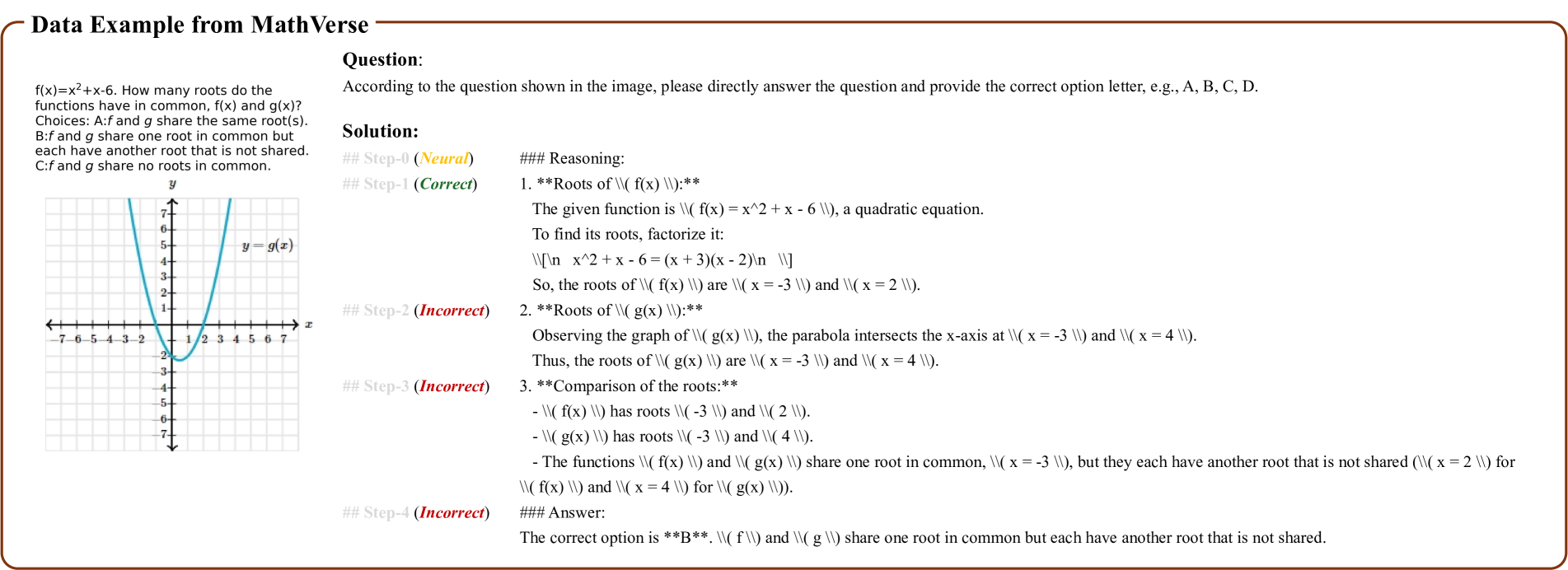
The image displays a mathematical problem from a source titled "Data Example from MathVerse." It presents a question about finding the number of common roots between two functions, `f(x)` and `g(x)`, accompanied by a graph of `g(x)` and a multi-step solution. The content is structured as a problem statement, a graph, and a detailed solution with reasoning.
### Components/Axes
1. **Header:** "Data Example from MathVerse" (top-left, brown text).
2. **Problem Statement (Left Column):**
* **Function Definition:** `f(x)=x²+x-6.`
* **Question:** "How many roots do the functions have in common, f(x) and g(x)?"
* **Choices:**
* A: `f` and `g` share the same root(s).
* B: `f` and `g` share one root in common but each have another root that is not shared.
* C: `f` and `g` share no roots in common.
3. **Graph (Left Column, below problem):**
* **Type:** Cartesian coordinate plot.
* **Title/Label:** `y = g(x)` (positioned to the right of the parabola).
* **X-axis:** Labeled `x`. Range from -7 to 7, with major grid lines at integer intervals.
* **Y-axis:** Labeled `y`. Range from -7 to 7, with major grid lines at integer intervals.
* **Data Series:** A single blue parabola opening upwards. It intersects the x-axis at two points.
4. **Solution Section (Right Column):**
* **Question Prompt:** "According to the question shown in the image, please directly answer the question and provide the correct option letter, e.g., A, B, C, D."
* **Solution Header:** "Solution:"
* **Step Labels (Left-aligned, colored):**
* `## Step-0 (Neutral)`
* `## Step-1 (Correct)`
* `## Step-2 (Incorrect)`
* `## Step-3 (Incorrect)`
* `## Step-4 (Incorrect)`
* **Reasoning and Answer (Right-aligned):**
* **### Reasoning:**
1. **Roots of `f(x)`:** States `f(x) = x^2 + x - 6` is quadratic. Factorizes it as `(x + 3)(x - 2)`. Concludes roots are `x = -3` and `x = 2`.
2. **Roots of `g(x)`:** States that by observing the graph, the parabola intersects the x-axis at `x = -3` and `x = 4`. Concludes roots are `x = -3` and `x = 4`.
3. **Comparison of the roots:** Lists roots for `f(x)` and `g(x)`. States they share one root (`x = -3`) but each has another unshared root (`x = 2` for `f(x)`, `x = 4` for `g(x)`).
* **### Answer:** "The correct option is **B**. `f` and `g` share one root in common but each have another root that is not shared."
### Detailed Analysis
* **Graph Data Points:** The blue parabola `y = g(x)` visually confirms the roots stated in the solution. It crosses the x-axis at approximately `(-3, 0)` and `(4, 0)`. Its vertex appears to be near `(0.5, -6.25)`.
* **Solution Logic:**
* **Step 1 (Correct):** Algebraically finds the roots of `f(x)` by factoring.
* **Step 2 (Incorrect):** Correctly identifies the roots of `g(x)` from the graph (`x = -3`, `x = 4`), but the step is labeled "Incorrect." This may indicate the step itself is correct, but its placement or labeling within a larger sequence is flawed, or it's part of a pedagogical demonstration of common errors.
* **Step 3 (Incorrect):** Correctly compares the roots and arrives at the right conclusion (one shared root), yet is also labeled "Incorrect." This reinforces that the labels may be part of an instructional framework highlighting potential missteps in reasoning order or presentation.
* **Step 4 (Incorrect):** This label appears without associated reasoning text, suggesting it might be a placeholder or an error in the source material.
* **Final Answer:** The reasoning correctly concludes that the functions share exactly one root (`x = -3`), leading to option **B**.
### Key Observations
1. **Discrepancy in Step Labels:** The most notable observation is that Steps 2 and 3 contain correct mathematical reasoning but are labeled "(Incorrect)." This strongly suggests the image is from an educational tool or dataset designed to analyze or teach problem-solving processes, where steps are tagged not just by correctness but by their role in a potential solution path (e.g., identifying common pitfalls in sequencing).
2. **Graph-Text Consistency:** The graphical representation of `g(x)` is perfectly consistent with the textual description of its roots in the solution.
3. **Clear Multiple-Choice Structure:** The problem is presented in a standard multiple-choice format with three distinct options.
### Interpretation
This image is a pedagogical artifact, likely from a dataset like MathVerse used for training or evaluating AI models on mathematical reasoning. It demonstrates a complete problem-solving workflow: interpreting a question, extracting data from a graph, performing algebraic manipulation, and comparing results to select a multiple-choice answer.
The "Incorrect" labels on logically sound steps are the key investigative element. They imply the source material is not just presenting a solution, but is annotated to reflect a more nuanced analysis of the solution process. This could be for:
* **Error Analysis:** Showing where a student might go wrong in their *explanation* even if the math is right.
* **Process Evaluation:** Grading the sequence or completeness of steps, not just the final answer.
* **Training Data:** Providing rich annotations for AI models to learn not just *what* is correct, but *how* to structure a correct explanation and avoid procedural missteps.
The core mathematical fact demonstrated is that two functions can share a subset of their roots. Here, `f(x)` and `g(x)` share the root `x = -3` but differ at `x = 2` and `x = 4`, respectively. This is a fundamental concept in algebra concerning the relationship between equations and their graphical representations.