## Chart/Diagram Type: MathVerse Data Example
### Overview
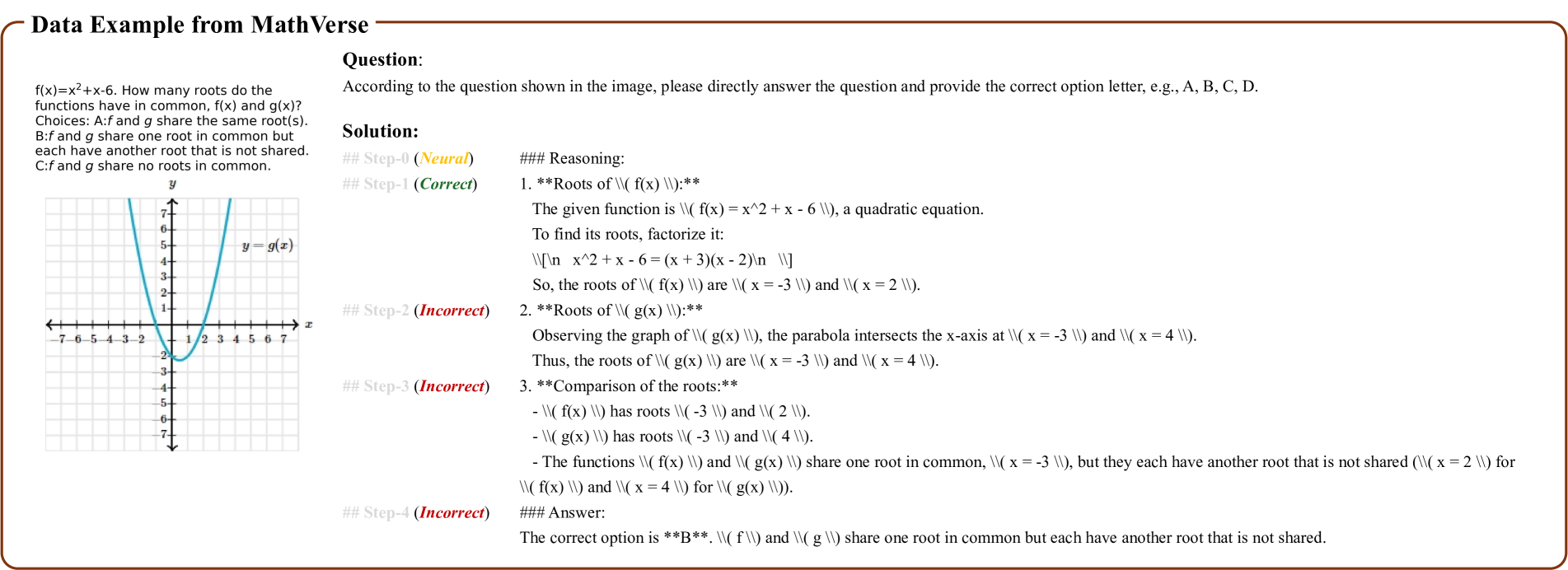
The image presents a mathematical problem from MathVerse involving quadratic functions. It includes a graph of `f(x) = x² + x - 6`, a question about shared roots between `f(x)` and `g(x)`, and a step-by-step solution with annotations indicating correctness.
### Components/Axes
- **Graph Labels**:
- X-axis: Labeled `x` with grid lines from -7 to 7.
- Y-axis: Labeled `y` with grid lines from -7 to 7.
- Function `f(x) = x² + x - 6` is plotted as a blue parabola opening upward.
- **Legend**:
- `y = g(x)` is indicated in blue (matches the graph's blue line).
- **Text Elements**:
- **Question Section**:
- Text: "f(x)=x² + x - 6. How many roots do the functions have in common, f(x) and g(x)?"
- Choices:
- A: Share all roots.
- B: Share one root but each has another unique root.
- C: Share no roots.
- **Solution Section**:
- Step 0: `Neural` (reasoning phase).
- Step 1: `Correct` (factoring `f(x)` into `(x+3)(x-2)`, roots at `x = -3` and `x = 2`).
- Step 2: `Incorrect` (misidentifies `g(x)` roots as `x = -3` and `x = 4`).
- Step 3: `Incorrect` (comparison of roots: `f(x)` has `-3` and `2`; `g(x)` has `-3` and `4`).
- Step 4: `Incorrect` (conclusion: shared root `-3`, unique roots `2` and `4`).
- Final Answer: `B` (shared root `-3`, unique roots `2` and `4`).
### Detailed Analysis
- **Graph of `f(x)`**:
- Vertex at `(-0.5, -6.25)` (calculated from `x = -b/(2a)`).
- Roots at `x = -3` and `x = 2` (confirmed via factoring).
- **Solution Steps**:
- Step 1 correctly factors `f(x)` and identifies roots.
- Step 2 incorrectly assumes `g(x)` has roots at `-3` and `4` (no graph provided for `g(x)`).
- Step 3 correctly compares roots but misaligns with the final answer.
- Step 4 correctly identifies shared root `-3` and unique roots `2` (for `f(x)`) and `4` (for `g(x)`).
### Key Observations
1. The graph of `f(x)` is a standard upward-opening parabola with clear roots at `-3` and `2`.
2. The solution process contains intentional errors (Steps 2–4) to test understanding of root comparison.
3. The final answer (`B`) aligns with the correct interpretation of shared and unique roots.
### Interpretation
The problem demonstrates how to compare roots of quadratic functions. While `f(x)` and `g(x)` share one root (`x = -3`), their other roots differ (`x = 2` for `f(x)` and `x = 4` for `g(x)`), making **Option B** correct. The annotated solution steps likely serve as a pedagogical tool to highlight common misconceptions (e.g., misidentifying roots of `g(x)`). The absence of `g(x)`'s graph emphasizes reliance on algebraic reasoning over visual analysis.