\n
## Screenshot: Plausibility Assessment Prompt
### Overview
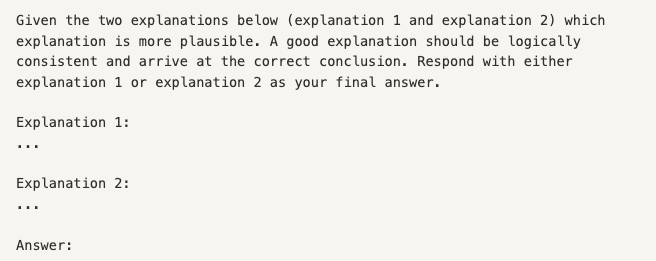
The image is a screenshot of a text-based prompt designed to assess the plausibility of two given explanations. It presents a question asking the user to choose between "explanation 1" and "explanation 2" based on logical consistency and correctness. The prompt includes placeholders for the actual explanations and an "Answer:" field for the user's response.
### Components/Axes
The screenshot contains the following textual elements:
* **Header:** "Given the two explanations below (explanation 1 and explanation 2) which explanation is more plausible. A good explanation should be logically consistent and arrive at the correct conclusion."
* **Explanation 1 Label:** "Explanation 1:"
* **Explanation 1 Placeholder:** "... " (representing the content of explanation 1)
* **Explanation 2 Label:** "Explanation 2:"
* **Explanation 2 Placeholder:** "... " (representing the content of explanation 2)
* **Answer Label:** "Answer:"
### Detailed Analysis or Content Details
The image does not contain any factual data or numerical values. It is a template for a reasoning task. The content of the explanations is represented by ellipses ("..."), indicating that the actual text is missing. The prompt is structured to elicit a choice between two provided explanations.
### Key Observations
The screenshot is a simple, text-based interface. The layout is straightforward, with clear labels for each section. The use of ellipses suggests that the explanations are intended to be dynamically populated.
### Interpretation
The image represents a task designed to evaluate critical thinking and reasoning skills. The prompt requires the user to analyze two explanations, assess their logical coherence, and select the more plausible one. The absence of specific content in the explanations highlights the focus on the *process* of evaluation rather than the subject matter itself. The prompt is likely part of a larger assessment or experiment related to cognitive abilities or decision-making. It is a test of the ability to discern between good and bad reasoning.