## Screenshot: Evaluation Prompt Template
### Overview
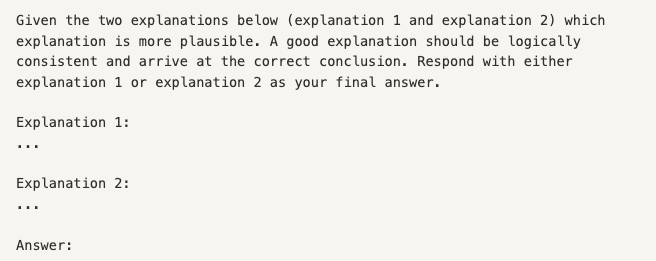
The image is a screenshot of a text-based prompt or template. It presents instructions for evaluating two hypothetical explanations ("Explanation 1" and "Explanation 2") and selecting the more plausible one based on logical consistency and correctness. The text is presented in a monospaced font on a light gray background, suggesting it may be from a code editor, terminal, or a plain text document.
### Components / Text Content
The image contains the following text, transcribed verbatim:
```
Given the two explanations below (explanation 1 and explanation 2) which
explanation is more plausible. A good explanation should be logically
consistent and arrive at the correct conclusion. Respond with either
explanation 1 or explanation 2 as your final answer.
Explanation 1:
...
Explanation 2:
...
Answer:
```
**Spatial Layout:**
- The main instruction paragraph is at the top.
- Below it, the labels "Explanation 1:" and "Explanation 2:" are listed vertically, each followed by an ellipsis (`...`) on the next line, indicating placeholder content.
- At the bottom, the label "Answer:" is present, also followed by a placeholder.
### Detailed Analysis / Content Details
- **Instruction Text:** The core directive is to compare two explanations for plausibility. The criteria for a "good explanation" are explicitly defined as being "logically consistent" and arriving at the "correct conclusion."
- **Structure:** The template is designed for a binary choice. The respondent is instructed to output either "explanation 1" or "explanation 2" as the final answer.
- **Placeholders:** The ellipses (`...`) under each explanation label signify that the actual content of the explanations is not provided in this image. This image is a shell or a prompt awaiting input.
### Key Observations
- The text is purely instructional and contains no data, charts, or diagrams.
- The language is precise and task-oriented, focusing on logical evaluation.
- The format is minimal and functional, with clear separation between the instruction, the input fields (for the explanations), and the output field (for the answer).
### Interpretation
This image does not contain factual data or a completed analysis. Instead, it represents a **meta-instruction** or a **prompt template**. Its purpose is to structure a reasoning task.
1. **Function:** It serves as a framework for an exercise in critical thinking or argument evaluation. The user (or an AI system) would be expected to populate "Explanation 1" and "Explanation 2" with specific arguments and then apply the given criteria to choose between them.
2. **Implied Context:** This template could be used in various contexts, such as:
* An educational setting for teaching logical reasoning.
* A testing or benchmarking scenario for AI models, evaluating their ability to assess argument quality.
* A step in a larger problem-solving workflow where multiple solution paths are compared.
3. **Underlying Principle:** The prompt enforces a clear, two-part standard for evaluation: internal coherence (logical consistency) and external validity (correctness of the conclusion). This moves beyond subjective preference to an objective, rule-based assessment.
In essence, the image provides the *scaffolding for a judgment call*, not the judgment itself. The actual informational content to be processed is absent, indicated by the placeholders.