## Text-Based Prompt: Explanation Evaluation Task
### Overview
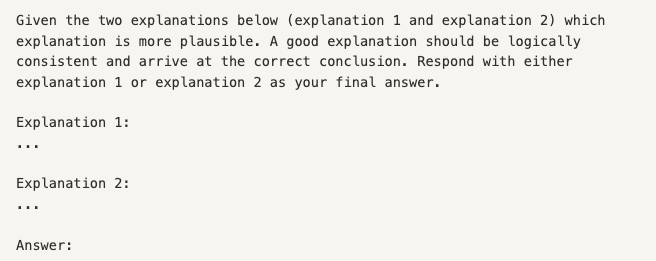
The image contains a textual prompt instructing the evaluation of two explanations (Explanation 1 and Explanation 2) for logical consistency and correctness. It emphasizes that a "good explanation" must be logically consistent and arrive at the correct conclusion. The user is directed to respond with either "explanation 1" or "explanation 2" as the final answer.
### Components/Axes
- **Textual Structure**:
- Header: Instructions for evaluating explanations.
- Placeholders:
- `Explanation 1: ...` (incomplete, marked with ellipses).
- `Explanation 2: ...` (incomplete, marked with ellipses).
- Footer: Prompt for the final answer ("Answer:").
### Detailed Analysis
- **Text Content**:
- The prompt explicitly defines criteria for evaluation: logical consistency and correctness of conclusion.
- Placeholders (`...`) indicate missing content for both explanations, suggesting the image is a template or incomplete example.
- No numerical data, charts, or diagrams are present.
### Key Observations
- The image lacks substantive content for Explanation 1 and Explanation 2, rendering them non-evaluable in their current state.
- The task is framed as a logical reasoning exercise but provides no actual data to analyze.
### Interpretation
This image appears to be a **template or instructional framework** for evaluating explanations, not a dataset or analytical result. The absence of completed explanations (`...`) implies it is either a placeholder for further input or a demonstration of the evaluation structure. The emphasis on logical consistency aligns with principles of deductive reasoning, but without concrete examples, no meaningful analysis can be performed. The prompt’s design suggests it may be part of a larger system for automated or human evaluation of argumentative content.