## Line Graph: Transaction Fee vs. Number of Transactions
### Overview
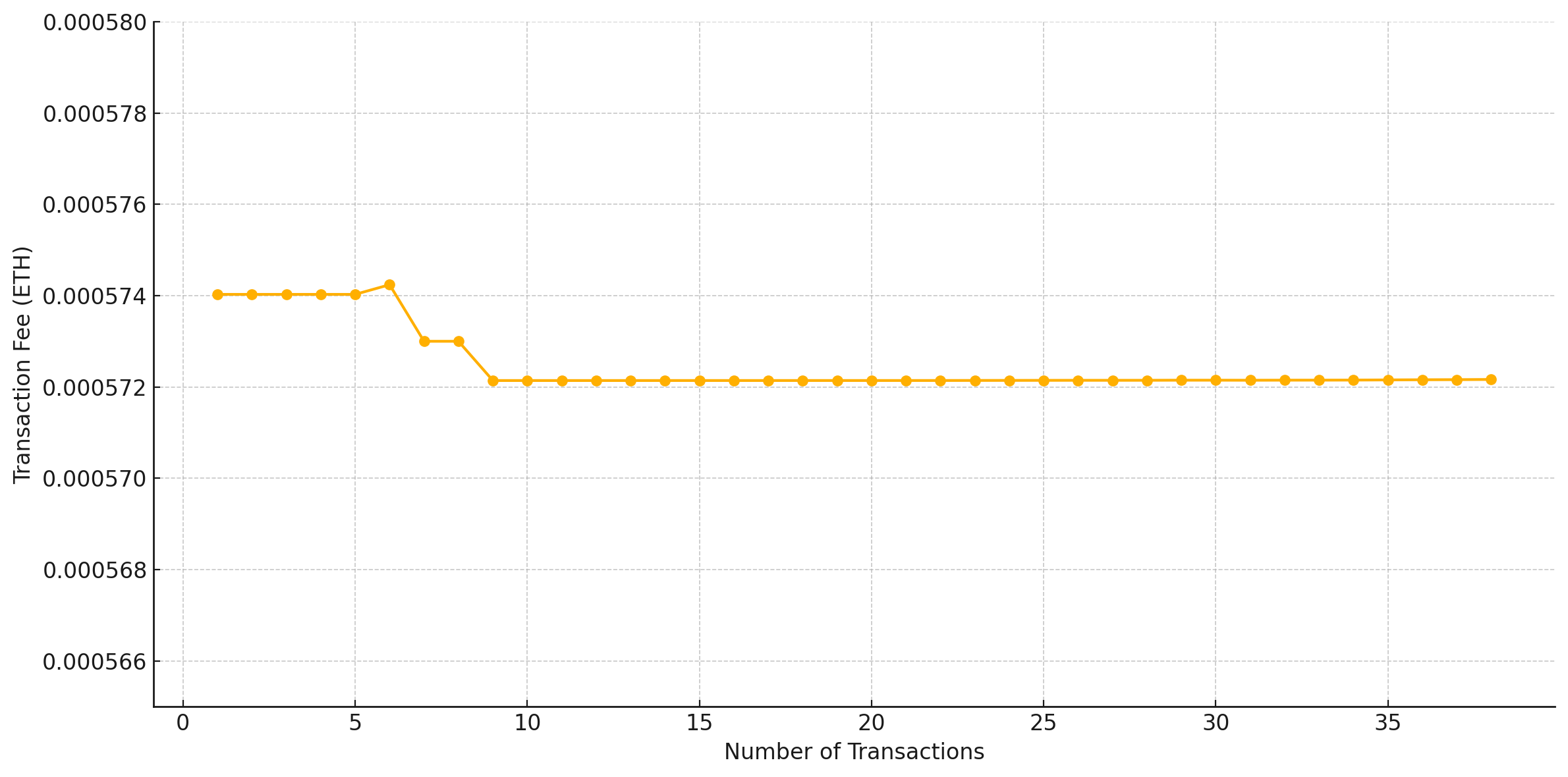
The graph illustrates the relationship between the number of transactions and the corresponding transaction fee in ETH. The fee remains constant at 0.000574 ETH for the first 5 transactions, then drops to 0.000572 ETH for transactions 6–37. The y-axis ranges from 0.000566 to 0.000580 ETH, with the x-axis spanning 0–37 transactions.
### Components/Axes
- **X-axis (Horizontal)**: Labeled "Number of Transactions," with increments of 5 (0, 5, 10, ..., 35).
- **Y-axis (Vertical)**: Labeled "Transaction Fee (ETH)," with increments of 0.000002 ETH (0.000566, 0.000568, ..., 0.000580).
- **Legend**: Positioned at the top-right corner, indicating an orange line representing "Transaction Fee."
### Detailed Analysis
- **Initial Segment (0–5 transactions)**:
- Transaction fee remains constant at **0.000574 ETH**.
- Data points are evenly spaced along the x-axis, forming a horizontal line.
- **Post-Drop Segment (6–37 transactions)**:
- Fee decreases to **0.000572 ETH** at transaction 6 and remains constant through transaction 37.
- The line is flat, indicating no further changes in fee despite increasing transaction volume.
- **Y-axis Range**:
- The fee never exceeds 0.000574 ETH or drops below 0.000572 ETH.
### Key Observations
1. **Tiered Fee Structure**: The fee decreases by 0.000002 ETH after 5 transactions, suggesting a volume-based discount.
2. **Stability Post-Discount**: No further fee adjustments occur beyond transaction 6, even as the number of transactions increases to 37.
3. **Precision**: All values are exact (e.g., 0.000574 ETH), with no rounding or approximation.
### Interpretation
The graph demonstrates a **tiered pricing model** where transaction fees decrease after a threshold (5 transactions) and stabilize. This could incentivize users to consolidate transactions or reward high-volume activity. The absence of further discounts beyond 6 transactions implies a fixed-rate structure for larger volumes, potentially simplifying cost calculations for users. The flat line post-discount highlights efficiency in fee management for bulk transactions, though it may limit incentives for extremely high-volume users beyond 37 transactions.