## Flowchart with Logical Statements: Entity Relationships and Properties
### Overview
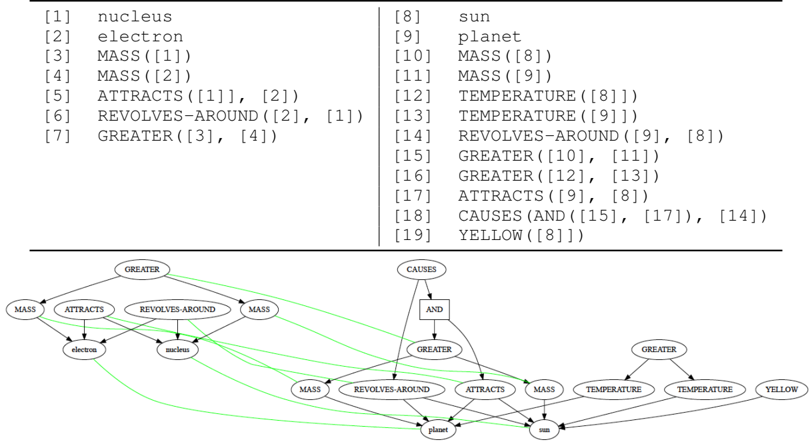
The image contains two primary components:
1. A **numbered list of logical/relational statements** (1–19) defining properties and interactions between entities.
2. A **directed flowchart** visualizing relationships between entities (e.g., nucleus, electron, sun, planet) via labeled edges (e.g., MASS, ATTRACTS, REVOLVES-AROUND).
---
### Components/Axes
#### List of Statements (Top Section)
- **Format**: `[N] [ENTITY/PROPERTY]` or `[N] [RELATION]([A], [B])`
- **Key Entities**:
- `nucleus` (1), `electron` (2), `sun` (8), `planet` (9)
- **Key Properties/Relations**:
- `MASS([X])` (3, 4, 10, 11), `ATTRACTS([A], [B])` (5, 17), `REVOLVES-AROUND([A], [B])` (6, 14), `GREATER([A], [B])` (7, 15, 16), `TEMPERATURE([X])` (12, 13), `CAUSES(AND([A], [B]), [C])` (18), `YELLOW([X])` (19).
#### Flowchart (Bottom Section)
- **Nodes**:
- `nucleus`, `electron`, `sun`, `planet`, `MASS`, `TEMPERATURE`, `YELLOW`.
- **Edges**:
- Directed arrows labeled with relations (e.g., `MASS`, `ATTRACTS`, `REVOLVES-AROUND`, `GREATER`, `CAUSES`, `YELLOW`).
- **Spatial Layout**:
- **Top-left**: `nucleus` and `electron` connected via `MASS`, `ATTRACTS`, and `REVOLVES-AROUND`.
- **Center**: `sun` and `planet` connected via `MASS`, `TEMPERATURE`, `GREATER`, and `YELLOW`.
- **Bottom**: `CAUSES` edge links `REVOLVES-AROUND` and `ATTRACTS` to `YELLOW`.
---
### Detailed Analysis
#### List of Statements
1. `[1] nucleus`
2. `[2] electron`
3. `[3] MASS([1])`
4. `[4] MASS([2])`
5. `[5] ATTRACTS([1], [2])`
6. `[6] REVOLVES-AROUND([2], [1])`
7. `[7] GREATER([3], [4])`
8. `[8] sun`
9. `[9] planet`
10. `[10] MASS([8])`
11. `[11] MASS([9])`
12. `[12] TEMPERATURE([8])`
13. `[13] TEMPERATURE([9])`
14. `[14] REVOLVES-AROUND([9], [8])`
15. `[15] GREATER([10], [11])`
16. `[16] GREATER([12], [13])`
17. `[17] ATTRACTS([9], [8])`
18. `[18] CAUSES(AND([15], [17]), [14])`
19. `[19] YELLOW([8])`
#### Flowchart Relationships
- **Nucleus-Electron**:
- `MASS` (3, 4), `ATTRACTS` (5), `REVOLVES-AROUND` (6).
- `GREATER` (7) indicates `MASS([1]) > MASS([2])`.
- **Sun-Planet**:
- `MASS` (10, 11), `TEMPERATURE` (12, 13), `REVOLVES-AROUND` (14).
- `GREATER` (15, 16) implies `MASS([8]) > MASS([9])` and `TEMPERATURE([8]) > TEMPERATURE([9])`.
- `ATTRACTS` (17) and `YELLOW` (19) are properties of the `sun`.
- **Causal Chain**:
- `CAUSES` (18) links `GREATER` (15, 16) and `ATTRACTS` (17) to `REVOLVES-AROUND` (14).
---
### Key Observations
1. **Hierarchical Structure**:
- `nucleus` and `electron` form a sub-system with mass and attraction properties.
- `sun` and `planet` form a larger system with mass, temperature, and color (yellow) properties.
2. **Causal Logic**:
- The `CAUSES` edge (18) suggests that the sun’s greater mass and attraction cause the planet to revolve around it.
3. **Color Property**:
- `YELLOW([8])` explicitly assigns the color yellow to the `sun`.
---
### Interpretation
This image models a simplified physical system using logical statements and a flowchart:
- **Entities**: `nucleus`, `electron`, `sun`, and `planet` are defined with properties (mass, temperature) and interactions (attraction, revolution).
- **Relationships**:
- The `nucleus` and `electron` interact via mass and attraction, with the electron revolving around the nucleus.
- The `sun` and `planet` share similar properties but differ in magnitude (greater mass/temperature for the sun).
- The `CAUSES` edge implies that the sun’s properties (mass, attraction) are the root cause of the planet’s orbital motion.
- **Notable Anomaly**:
- The `YELLOW` property is uniquely assigned to the `sun`, suggesting a categorical distinction (e.g., color as a defining trait).
This structure could represent a physics-based ontology or a simplified model of celestial mechanics, where logical rules govern entity behavior.