## Diagram: Logical Predicate Mapping of Physical Systems
### Overview
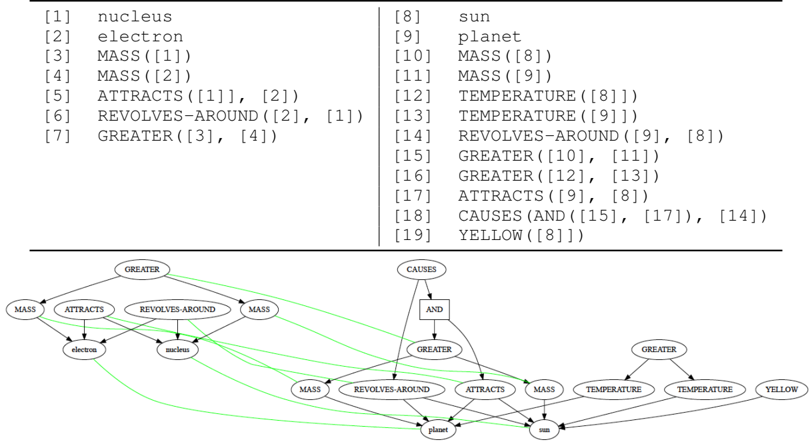
The image presents a formal logical representation of two physical systems—an atomic system (nucleus and electron) and a planetary system (sun and planet)—using predicate logic. The top section contains a numbered list of 19 logical statements defining the properties and relationships of these entities. The bottom section displays a directed graph (node-link diagram) that visualizes these logical relationships, mapping the predicates to the entities.
### Components/Axes
**Top Section: Logical Predicate List**
The list is organized into two columns.
* **Left Column (Atomic System):**
* [1] nucleus
* [2] electron
* [3] MASS([1])
* [4] MASS([2])
* [5] ATTRACTS([1], [2])
* [6] REVOLVES-AROUND([2], [1])
* [7] GREATER([3], [4])
* **Right Column (Planetary System):**
* [8] sun
* [9] planet
* [10] MASS([8])
* [11] MASS([9])
* [12] TEMPERATURE([8])
* [13] TEMPERATURE([9])
* [14] REVOLVES-AROUND([9], [8])
* [15] GREATER([10], [11])
* [16] GREATER([12], [13])
* [17] ATTRACTS([9], [8])
* [18] CAUSES(AND([15], [17]), [14])
* [19] YELLOW([8])
**Bottom Section: Directed Graph**
* **Nodes:** Represent entities (ovals) and logical operators (ovals and one rectangle).
* **Edges:** Directed lines (arrows) indicating the flow of relationships.
* **Color Coding:**
* **Black lines:** Represent standard logical relationships and causal flows.
* **Green lines:** Specifically connect "MASS" nodes to their respective entities ("electron", "nucleus", "planet", "sun").
### Detailed Analysis
The diagram is structured into two primary clusters connected by logical operators:
1. **Atomic Cluster (Left):**
* The "nucleus" and "electron" are at the bottom.
* "MASS" nodes connect to both "nucleus" and "electron" via green lines.
* "ATTRACTS" and "REVOLVES-AROUND" nodes connect to both entities.
* A "GREATER" node sits at the top, connecting to the "MASS" nodes of the nucleus and electron.
2. **Planetary Cluster (Right):**
* "Sun" and "planet" are at the bottom.
* "MASS" nodes connect to "planet" and "sun" via green lines.
* "TEMPERATURE" nodes connect to "sun" and "planet".
* "YELLOW" connects to "sun".
* "REVOLVES-AROUND" and "ATTRACTS" connect to "planet" and "sun".
* A "GREATER" node connects to the "TEMPERATURE" nodes.
3. **Logical Integration (Center/Top):**
* A "CAUSES" node is positioned at the top center.
* It connects to an "AND" node (represented as a rectangle).
* The "AND" node receives inputs from the "GREATER" (mass) and "ATTRACTS" nodes, which then points to the "REVOLVES-AROUND" relationship.
### Key Observations
* **Structural Analogy:** The diagram visually demonstrates that the atomic system and the planetary system share an identical logical structure regarding mass, attraction, and revolution.
* **Logical Gate:** The "AND" node (Statement [18]) acts as a logical gate, asserting that the combination of "GREATER" mass and "ATTRACTS" relationship is the cause of the "REVOLVES-AROUND" behavior.
* **Visual Distinction:** The use of green lines for "MASS" relationships suggests a specific categorization of properties versus dynamic interactions (which are represented by black lines).
* **Asymmetry:** While the atomic and planetary systems share many logical predicates, the planetary system includes additional properties ("TEMPERATURE" and "YELLOW") that are not present in the atomic system's logical set.
### Interpretation
This diagram serves as a formalization of **analogical reasoning** in physics. It maps the micro-scale (atomic) and macro-scale (planetary) systems onto a shared logical framework.
* **Peircean/Logical Analysis:** The diagram functions as an "icon" of the logical structure. By abstracting physical objects into nodes and physical laws into predicates, it allows for the comparison of disparate systems.
* **Causal Logic:** Statement [18] is the most significant, as it attempts to define the *mechanism* of revolution. It posits that revolution is not a primitive fact, but a derived consequence of mass disparity and attractive force.
* **Reading Between the Lines:** The diagram implies that the "GREATER" mass relationship is a fundamental property (hence the green lines connecting mass to entities), whereas "REVOLVES-AROUND" is a behavioral outcome. The inclusion of "YELLOW" and "TEMPERATURE" for the sun/planet system, but not the atomic system, highlights the limitations of the analogy—the systems are structurally similar in mechanics but distinct in their specific physical attributes.