## Diagram: Semantic Network of Astronomical Relationships
### Overview
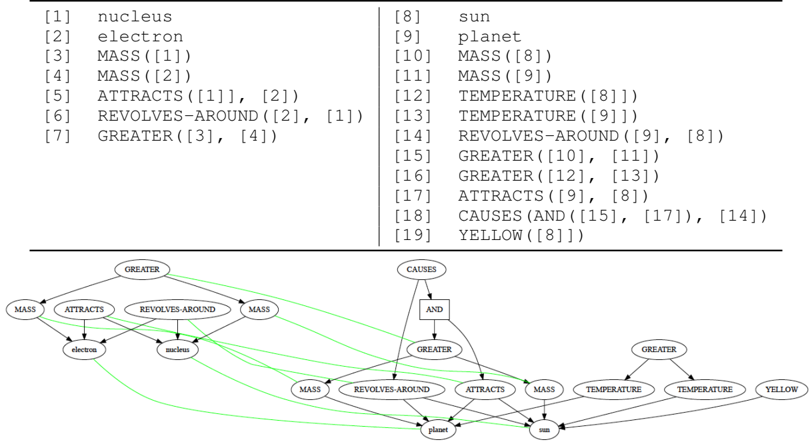
The image presents a semantic network diagram illustrating relationships between astronomical entities (nucleus, electron, sun, planet) and their properties (mass, temperature, attraction, revolution). A key is provided above the diagram, mapping numerical identifiers to specific concepts or relationships. The diagram itself uses nodes to represent these concepts and directed edges to represent the relationships between them.
### Components/Axes
The image consists of two main parts: a key and the diagram itself.
**Key:**
The key is a list of numbered items, each defining a concept or relationship.
* [1] nucleus
* [2] electron
* [3] MASS([1]) - Mass of the nucleus
* [4] MASS([2]) - Mass of the electron
* [5] ATTRACTS([1], [2]) - Nucleus attracts electron
* [6] REVOLVES-AROUND([2], [1]) - Electron revolves around nucleus
* [7] GREATER([3], [4]) - Mass of nucleus is greater than mass of electron
* [8] sun
* [9] planet
* [10] MASS([8]) - Mass of the sun
* [11] MASS([9]) - Mass of the planet
* [12] TEMPERATURE([8]) - Temperature of the sun
* [13] TEMPERATURE([9]) - Temperature of the planet
* [14] REVOLVES-AROUND([9], [8]) - Planet revolves around sun
* [15] GREATER([10], [11]) - Mass of sun is greater than mass of planet
* [16] GREATER([12], [13]) - Temperature of sun is greater than temperature of planet
* [17] ATTRACTS([9], [8]) - Sun attracts planet
* [18] CAUSES (AND([15], [17]), [14]) - Sun's mass and attraction cause the planet to revolve around it.
* [19] YELLOW([8]) - Sun is yellow
**Diagram:**
The diagram consists of nodes (ovals) representing the concepts and directed edges (arrows) representing the relationships. The nodes are labeled with the concepts from the key.
### Detailed Analysis or Content Details
The diagram shows the following relationships:
* **Nucleus & Electron:**
* MASS is associated with both nucleus and electron.
* ATTRACTS connects nucleus to electron.
* REVOLVES-AROUND connects electron to nucleus.
* GREATER connects the mass of the nucleus to the mass of the electron.
* **Sun & Planet:**
* MASS is associated with both sun and planet.
* TEMPERATURE is associated with both sun and planet.
* ATTRACTS connects sun to planet.
* REVOLVES-AROUND connects planet to sun.
* GREATER connects the mass of the sun to the mass of the planet.
* GREATER connects the temperature of the sun to the temperature of the planet.
* **Causal Relationship:**
* A complex relationship is represented by "CAUSES". It involves an "AND" gate combining GREATER(mass of sun vs planet) and ATTRACTS(sun attracts planet), which then causes REVOLVES-AROUND(planet revolves around sun).
* **Color:**
* YELLOW is associated with the sun.
### Key Observations
* The diagram uses a consistent structure to represent relationships between different astronomical entities.
* The "CAUSES" relationship is more complex, involving a logical "AND" operation.
* The diagram visually represents a hierarchical structure, with the nucleus-electron system and the sun-planet system being distinct but similarly structured.
* The diagram is a simplified representation of complex physical phenomena.
### Interpretation
The diagram illustrates a simplified model of astronomical relationships, focusing on mass, attraction, temperature, and orbital motion. It demonstrates how these properties are interconnected and how they contribute to the observed behavior of celestial bodies. The use of a semantic network allows for a clear and concise representation of these relationships. The "CAUSES" node highlights the idea that physical laws (in this case, gravity and mass) are responsible for observed phenomena (planetary orbits). The diagram is a conceptual model, not a quantitative one, and does not provide specific values for mass, temperature, or distances. It serves as a visual aid for understanding the fundamental relationships between these entities. The diagram is a form of knowledge representation, encoding information about the solar system in a structured and accessible format.