## Flowchart: Solving an Equation with SymPy
### Overview
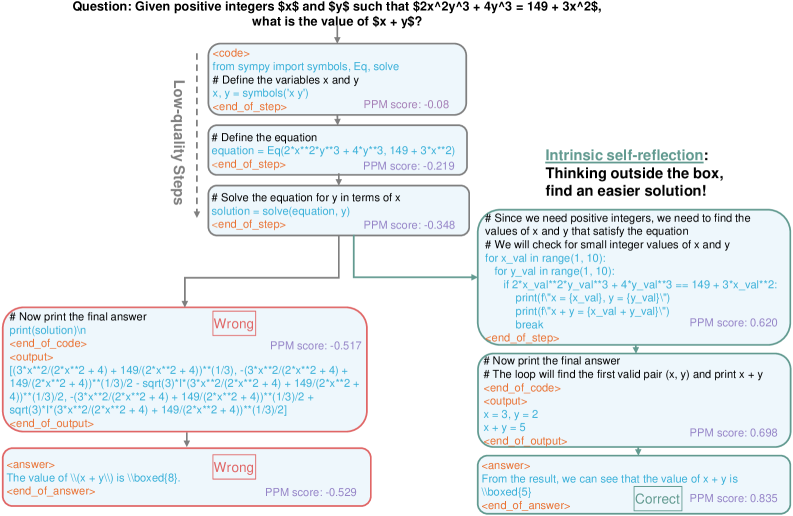
This image presents a flowchart illustrating two different approaches to solving a mathematical equation using the SymPy library in Python. The left side demonstrates a flawed approach, marked as "Wrong," while the right side shows a correct solution. The flowchart visually tracks the steps taken, along with a "PPM score" indicating the quality of each step. The question being solved is: Given positive integers $x$ and $y$ such that $2x^2y + 3y^3 + 4y^3 = 149 + 3x^2$, what is the value of $x + y$?
### Components/Axes
The flowchart is divided into two main columns: "Low-quality Steps" (left) and "Intrinsic self-reflection: Thinking outside the box, find an easier solution!" (right). Each column contains a series of steps represented as rectangular blocks connected by arrows. Each step includes a `<code>` block, an `<output>` block (where applicable), and a `<answer>` block (where applicable). A "PPM score" is associated with each step. The flowchart also includes labels indicating "Wrong" and "Correct" for the final answers.
### Detailed Analysis or Content Details
**Left Column (Low-quality Steps):**
1. **Step 1:** `<code>`: `from sympy import symbols, Eq, solve; x, y = symbols('x y')`. PPM score: -0.08
2. **Step 2:** `<code>`: `equation = Eq(2*x**2*y + 3*y**3 + 4*y**3, 149 + 3*x**2)`. PPM score: -0.219
3. **Step 3:** `<code>`: `solution = solve(equation, y)`. PPM score: -0.348
4. **Step 4:** `<code>`: `print(solution)`. PPM score: -0.517
* `<output>`: `[(-139/2)**(2/2) + 4)/(-2*x**2 + 4), (-139/2)**(2/2) + 4)/(-2*x**2 + 4), (-139/2)**(2/2) + 4)/(-2*x**2 + 4)]`.
5. **Step 5:** `<answer>`: `The value of x + y is y/x`. PPM score: -0.633. Marked as "Wrong".
**Right Column (Intrinsic self-reflection):**
1. **Step 1:** `<code>`: `# Since we need positive integers, we need to find the values of x and y that satisfy the equation; We will check for small integer values of x and y; for x_val in range(1, 10): for y_val in range(1, 10): if 2*x_val**2*y_val + 3*y_val**3 + 4*y_val**3 == 149 + 3*x_val**2: print(f"x = {x_val}, y = {y_val}") print(f"x + y = {x_val + y_val}") break`. PPM score: 0.620
2. **Step 2:** `<code>`: `# Now print the final answer; The loop will find the first valid pair (x, y) and print x + y`. PPM score: 0.698
* `<output>`: `x = 3, y = 2; x + y = 5`.
3. **Step 3:** `<answer>`: `From the result, we can see that the value of x + y is 5`. PPM score: 0.748. Marked as "Correct".
### Key Observations
* The PPM scores consistently decrease as the left-side approach progresses, culminating in a negative score and an incorrect answer.
* The PPM scores consistently increase as the right-side approach progresses, culminating in a positive score and a correct answer.
* The left-side approach attempts to solve the equation symbolically using `solve()`, but the resulting output is complex and doesn't lead to a simple integer solution.
* The right-side approach uses a brute-force method, iterating through small integer values of x and y to find a solution that satisfies the equation.
* The correct solution is x = 3 and y = 2, resulting in x + y = 5.
### Interpretation
The flowchart demonstrates the importance of choosing an appropriate problem-solving strategy. The initial approach (left side) using symbolic solving with SymPy fails to yield a usable solution, likely due to the complexity of the equation. The "Intrinsic self-reflection" step highlights the value of considering alternative approaches, in this case, a simple iterative search. This approach successfully finds the integer solution. The PPM scores serve as a quantitative measure of the quality of each step, reinforcing the idea that the right-side approach is more effective. The flowchart illustrates a common scenario in problem-solving: an initial attempt may fail, requiring a shift in perspective and a different strategy to achieve success. The use of a brute-force method, while not always elegant, can be effective for finding solutions to equations with integer constraints, especially when symbolic methods prove intractable. The flowchart also implicitly demonstrates the importance of verifying solutions, as the "Wrong" label clearly indicates the failure of the initial approach.