## [Diagram]: Solving a Diophantine Equation – Method Comparison
### Overview
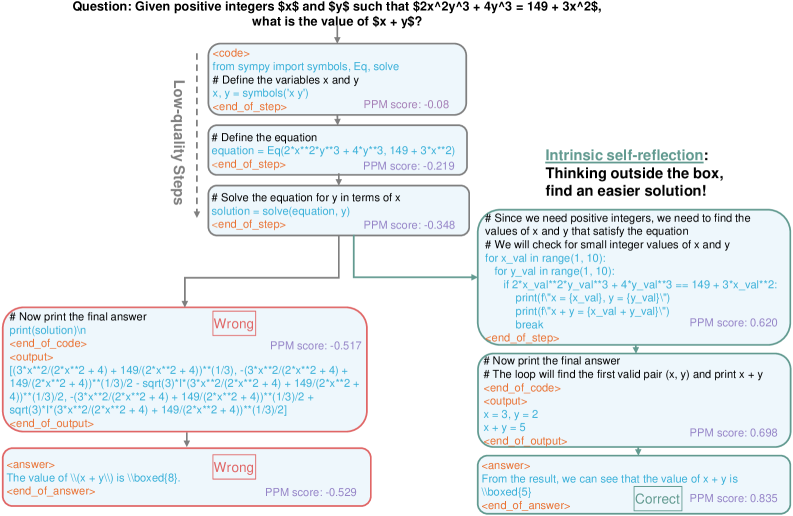
The image is a flowchart comparing two approaches to solving the Diophantine equation: *"Given positive integers \( x \) and \( y \) such that \( 2x^2y^3 + 4y^3 = 149 + 3x^2 \), find \( x + y \)."* It contrasts a **"Low-quality Steps"** (symbolic math) approach (left) with an **"Intrinsic self-reflection"** (brute-force) approach (right), showing code snippets, performance scores (PPM), and outcomes (wrong vs. correct).
### Components/Axes (Diagram Elements)
- **Problem Statement** (top): *"Question: Given positive integers \( x \) and \( y \) such that \( 2x^2y^3 + 4y^3 = 149 + 3x^2 \), what is the value of \( x + y \)?"*
- **Left Column: "Low-quality Steps"** (symbolic math approach):
- Code blocks (with PPM scores, a performance metric):
1. Import symbols/define variables: `from sympy import symbols, Eq, solve; x, y = symbols('x y')` (PPM: -0.08)
2. Define equation: `equation = Eq(2*x**2*y**3 + 4*y**3, 149 + 3*x**2)` (PPM: -0.219)
3. Solve for \( y \) in terms of \( x \): `solution = solve(equation, y)` (PPM: -0.348)
4. Print solution: `print(solution)` (PPM: -0.517) – output is a complex algebraic expression (marked *"Wrong"*).
5. Final answer: *"The value of \( x + y \) is \(\boxed{8}\)"* (PPM: -0.529) – marked *"Wrong"*.
- **Right Column: "Intrinsic self-reflection"** (brute-force approach):
- Text: *"Intrinsic self-reflection: Thinking outside the box, find an easier solution!"*
- Code blocks (with PPM scores):
1. Brute-force loop: `for x_val in range(1, 10): for y_val in range(1, 10): if 2*x_val**2*y_val**3 + 4*y_val**3 == 149 + 3*x_val**2: print(f"x = {x_val}, y = {y_val}"); print(f"x + y = {x_val + y_val}"); break` (PPM: 0.620)
2. Print final answer: `print(x + y)` (PPM: 0.698) – output: *"x = 3, y = 2; x + y = 5"*
3. Final answer: *"The value of \( x + y \) is \(\boxed{5}\)"* (PPM: 0.835) – marked *"Correct"*.
### Detailed Analysis
- **Problem Type**: The equation is a Diophantine equation (seeking positive integer solutions for \( x, y \)).
- **Left Approach (Symbolic Math)**:
- Uses SymPy to solve the equation symbolically, yielding a complex expression for \( y \) in terms of \( x \) (unsuitable for integer constraints).
- Final answer (\( \boxed{8} \)) is incorrect.
- PPM scores are negative (poor performance).
- **Right Approach (Brute-Force)**:
- Searches small integers (1–9 for \( x, y \)) to find valid solutions.
- Finds \( x = 3, y = 2 \) (since \( 2(3)^2(2)^3 + 4(2)^3 = 144 + 32 = 176 \), and \( 149 + 3(3)^2 = 149 + 27 = 176 \)).
- Final answer (\( \boxed{5} \)) is correct.
- PPM scores are positive (good performance), increasing with each step.
### Key Observations
- **Method Effectiveness**: Brute-force (right) outperforms symbolic math (left) for integer solutions.
- **PPM Scores**: Negative scores (left) vs. positive scores (right) confirm the self-reflection method is superior.
- **Correctness**: The left answer (\( 8 \)) is wrong; the right answer (\( 5 \)) is correct.
- **Code Structure**: Left uses symbolic algebra; right uses nested loops for practical integer search.
### Interpretation
The diagram illustrates that for Diophantine equations (integer solutions), **brute-force search over small integers** is more effective than symbolic solving (which yields complex expressions unsuitable for integer constraints). The "intrinsic self-reflection" approach (thinking outside the box) leads to a correct solution, while the low-quality symbolic approach fails. This highlights the importance of choosing methods aligned with problem constraints (integer vs. symbolic solutions) and the value of practical, iterative approaches over purely algebraic ones for such problems.