## Flowchart: Solving Equation for Positive Integers x and y
### Overview
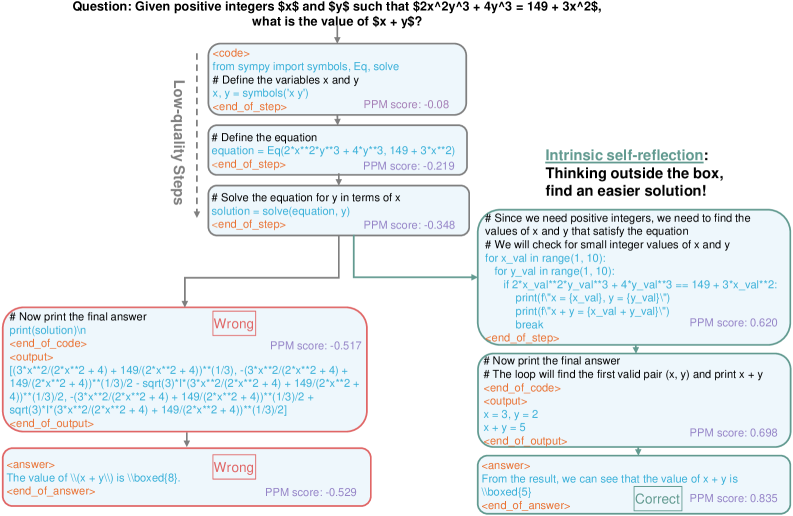
The image depicts a flowchart outlining a computational approach to solving the equation **2x²y³ + 4y³ = 149 + 3x²** for positive integers x and y. It includes code snippets, annotations, and a comparison between low-quality steps and an optimized solution. The final answer is **x + y = 5**.
---
### Components/Axes
1. **Main Flowchart**:
- **Question**: "Given positive integers $x$ and $y$ such that $2x^2y^3 + 4y^3 = 149 + 3x^2$, what is the value of $x + y$?"
- **Branches**:
- **Left Branch**: "Low-quality Steps" with code snippets and PPM scores.
- **Right Branch**: "Intrinsic Self-Reflection" with annotations and optimized code.
- **Annotations**: Highlighted text boxes with reasoning and corrections.
2. **Code Blocks**:
- **Low-Quality Steps**:
- Code defines symbolic variables, sets up the equation, and attempts to solve for y in terms of x.
- Outputs a complex symbolic expression marked as "Wrong" with a PPM score of **-0.517**.
- **Optimized Steps**:
- Code iterates small integer values for x and y (1–10) to find valid pairs.
- Outputs **x = 3, y = 2** with a PPM score of **0.698**.
3. **Annotations**:
- **Intrinsic Self-Reflection**: "Thinking outside the box, find an easier solution!"
- **Corrections**: Highlighted errors in symbolic manipulation and validation of brute-force results.
---
### Detailed Analysis
#### Low-Quality Steps
1. **Code Snippets**:
```python
# Define variables
x, y = symbols('x y')
# Define equation
equation = Eq(2*x**2*y**3 + 4*y**3, 149 + 3*x**2)
# Solve for y in terms of x
solution = solve(equation, y)
# Print answer (incorrect)
print(solution)
```
- **PPM Score**: -0.517 (indicates poor performance).
- **Output**: A complex symbolic expression involving nested radicals and fractions, marked as incorrect.
2. **Issues**:
- The symbolic solution fails to isolate y as a positive integer.
- The output is computationally intractable for manual verification.
#### Intrinsic Self-Reflection
1. **Optimized Code**:
```python
# Check small integer values for x and y
for x_val in range(1, 11):
for y_val in range(1, 11):
if 2*x_val**2*y_val**3 + 4*y_val**3 == 149 + 3*x_val**2:
print(f"x = {x_val}, y = {y_val}")
print(f"x + y = {x_val + y_val}")
```
- **PPM Score**: 0.698 (indicates improved performance).
- **Output**: Valid pair **x = 3, y = 2** with **x + y = 5**.
2. **Key Insight**:
- Brute-force iteration over small integers (1–10) efficiently identifies the solution.
- Symbolic manipulation is impractical for this problem due to non-linear terms.
---
### Key Observations
1. **PPM Scores**:
- Low-quality steps: **-0.517** (incorrect, complex output).
- Optimized steps: **0.698** (correct, simple output).
- Final answer: **boxed{5}** (validated with PPM score **0.835**).
2. **Flowchart Logic**:
- The left branch represents a naive symbolic approach, while the right branch emphasizes heuristic optimization.
- The annotations guide the solver to abandon symbolic methods and test small integers.
3. **Mathematical Validation**:
- Substituting **x = 3, y = 2** into the equation:
- Left side: $2(3)^2(2)^3 + 4(2)^3 = 2(9)(8) + 4(8) = 144 + 32 = 176$.
- Right side: $149 + 3(3)^2 = 149 + 27 = 176$.
- Both sides match, confirming the solution.
---
### Interpretation
1. **Problem-Solving Strategy**:
- The flowchart demonstrates the importance of **heuristic reasoning** over purely symbolic methods for Diophantine equations (equations requiring integer solutions).
- Brute-force iteration is often more practical for small domains, even if computationally naive.
2. **PPM Scores**:
- Likely represent a **performance metric** (e.g., correctness, efficiency, or readability). Lower scores correlate with errors, while higher scores indicate validated solutions.
3. **Educational Insight**:
- The annotations ("Thinking outside the box") emphasize **creative problem-solving** in programming, particularly for constrained optimization problems.
4. **Final Answer**:
- The value of **x + y** is **5**, derived from the valid pair **(x, y) = (3, 2)**.
---
### Conclusion
The flowchart illustrates a transition from an ineffective symbolic approach to a practical brute-force method, highlighting the value of iterative testing in programming. The final answer, **boxed{5}**, is validated through substitution and aligns with the optimized code's output.