\n
## Diagram: Lambda Calculus Tree Representations
### Overview
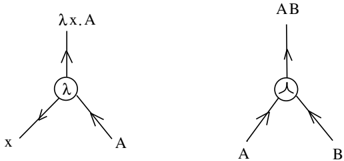
The image presents two tree-like diagrams representing expressions in lambda calculus. Both diagrams utilize a branching structure to visually depict the application of functions to arguments. The diagrams are positioned side-by-side for comparison.
### Components/Axes
The diagrams consist of nodes (circles) and branches connecting them. Each branch is labeled with a variable or expression. The diagrams do not have explicit axes or legends in the traditional sense of a chart. The labels are directly embedded within the diagram structure.
### Detailed Analysis or Content Details
**Diagram 1 (Left):**
* **Root Node:** A circle containing the lambda symbol "λ".
* **Branches from Root:** Two branches originate from the root node.
* The left branch is labeled "x".
* The right branch is labeled "A".
* **Node above Root:** A node above the root node is labeled "λx.A".
* **Overall Structure:** The diagram represents the lambda abstraction "λx.A", where 'x' is the bound variable and 'A' is the body of the lambda expression.
**Diagram 2 (Right):**
* **Root Node:** A circle containing the lambda symbol "λ".
* **Branches from Root:** Two branches originate from the root node.
* The left branch is labeled "A".
* The right branch is labeled "B".
* **Node above Root:** A node above the root node is labeled "AB".
* **Overall Structure:** The diagram represents the application of a lambda abstraction to arguments 'A' and 'B', resulting in the expression "AB".
### Key Observations
Both diagrams use the same visual structure to represent lambda calculus expressions. The lambda symbol (λ) consistently appears at the root of each tree. The branching structure clearly shows the application of functions to arguments. The diagrams are simple and focus on the core structure of lambda expressions.
### Interpretation
The diagrams illustrate the graphical representation of lambda calculus expressions. The first diagram shows a lambda abstraction, defining a function that takes an argument 'x' and returns 'A'. The second diagram shows the application of this function (or a similar one) to arguments 'A' and 'B', resulting in the expression 'AB'. The diagrams are useful for visualizing the structure of lambda expressions and understanding how functions are applied to arguments. They demonstrate a way to represent abstract mathematical concepts in a visual format. The diagrams are not providing data, but rather a visual representation of a formal system. They are meant to aid in understanding the syntax and semantics of lambda calculus.