## Diagram: Lambda (λ) Transformation and Interaction Models
### Overview
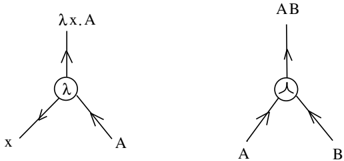
The image contains two distinct diagrams illustrating abstract transformations involving a central operator labeled **λ**. Both diagrams use directional arrows to represent relationships between variables or entities. The first diagram emphasizes a transformation process, while the second focuses on interaction or combination.
---
### Components/Axes
#### Diagram 1 (Left):
- **Central Node**: A circle labeled **λ** (Greek letter lambda).
- **Input Arrows**:
- **x**: Arrows pointing *into* λ from the left.
- **A**: Arrows pointing *into* λ from the right.
- **Output Arrow**:
- **λx.A**: Arrow pointing *out of* λ toward the top, labeled as the result of the transformation.
#### Diagram 2 (Right):
- **Central Node**: A circle labeled **λ**.
- **Input Arrows**:
- **A**: Arrows pointing *into* λ from the bottom-left.
- **B**: Arrows pointing *into* λ from the bottom-right.
- **Output Arrow**:
- **AB**: Arrow pointing *out of* λ toward the top, labeled as the combined result.
---
### Detailed Analysis
#### Diagram 1:
- **Flow**:
- Inputs **x** (left) and **A** (right) are processed by **λ**, producing **λx.A** (top).
- The notation **λx.A** suggests a composition of operations, where **λ** acts on **x** and **A** to generate a new entity.
- **Interpretation**: This could represent a mathematical function, logical operation, or computational process where **λ** mediates between **x** and **A**.
#### Diagram 2:
- **Flow**:
- Inputs **A** (bottom-left) and **B** (bottom-right) are combined via **λ** to produce **AB** (top).
- The arrow labels **AB** imply a direct interaction or aggregation of **A** and **B** under the influence of **λ**.
- **Interpretation**: This resembles a binary operation (e.g., addition, multiplication, or logical AND) where **λ** acts as a mediator or operator.
---
### Key Observations
1. **Consistency of λ**: Both diagrams use **λ** as the central operator, suggesting it plays a unifying role in transformations or interactions.
2. **Directionality**: Arrows indicate unidirectional flow, emphasizing causality or dependency (e.g., inputs → output).
3. **Notation**: The use of **λx.A** and **AB** implies algebraic or symbolic manipulation, common in lambda calculus, category theory, or functional programming.
---
### Interpretation
- **Technical Context**: These diagrams likely represent concepts from lambda calculus, category theory, or functional programming.
- In lambda calculus, **λ** denotes abstraction, and **λx.A** could represent a function taking **x** and returning **A**.
- In category theory, **λ** might symbolize a natural transformation or functor, while **AB** could denote a product or coproduct.
- **Relationships**:
- Diagram 1 highlights **transformation** (input → output via λ).
- Diagram 2 emphasizes **combination** (inputs A and B → output AB via λ).
- **Anomalies**: No numerical values or scales are present, so quantitative analysis is not applicable. The focus is purely on symbolic relationships.
---
### Conclusion
The diagrams abstractly model processes where **λ** acts as a mediator or operator. Diagram 1 illustrates a unary/binary transformation, while Diagram 2 depicts a binary interaction. These could underpin formal systems in mathematics, computer science, or logic, emphasizing the role of **λ** in structuring relationships between entities.