# Technical Document Extraction: Diagram Analysis
## Diagram Overview
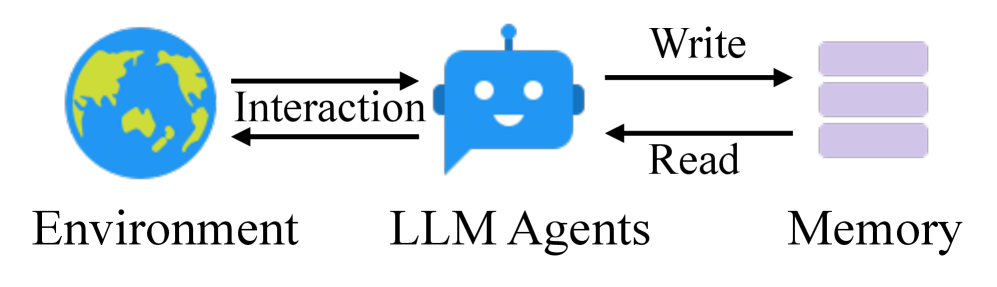
The image depicts a **component interaction diagram** illustrating the relationship between three core elements: **Environment**, **LLM Agents**, and **Memory**. The diagram uses directional arrows to represent data flow and interactions.
---
## Component Breakdown
### 1. Environment
- **Label**: "Environment" (bottom-left)
- **Visual Representation**: A globe icon (blue with green landmasses).
- **Function**: Represents external systems, users, or real-world data sources interacting with the LLM Agents.
### 2. LLM Agents
- **Label**: "LLM Agents" (center)
- **Visual Representation**: A blue robot icon with a speech bubble.
- **Function**: Acts as the central processing unit, interacting with the Environment and managing Memory.
### 3. Memory
- **Label**: "Memory" (top-right)
- **Visual Representation**: Three stacked horizontal rectangles (purple).
- **Function**: Stores data written by LLM Agents and provides read access for subsequent operations.
---
## Interaction Flow
1. **Environment ↔ LLM Agents**:
- **Bidirectional Arrows**: Labeled "Interaction".
- **Direction**:
- Environment → LLM Agents: Input data or commands.
- LLM Agents → Environment: Output responses or actions.
2. **LLM Agents → Memory**:
- **Unidirectional Arrows**:
- **Write**: Data is stored in Memory.
- **Read**: Data is retrieved from Memory.
---
## Key Observations
- **No Data Trends or Numerical Values**: The diagram is conceptual, focusing on system architecture rather than quantitative analysis.
- **Symbolic Representation**:
- The speech bubble on LLM Agents implies communication capabilities.
- Stacked rectangles for Memory suggest layered or hierarchical storage.
- **No Legends or Axes**: The diagram lacks numerical scales, categories, or color-coded legends.
---
## Transcribed Text
- **Labels**:
- Environment
- LLM Agents
- Memory
- **Arrow Labels**:
- Interaction (bidirectional)
- Write (LLM Agents → Memory)
- Read (LLM Agents → Memory)
---
## Conclusion
This diagram outlines a high-level architecture where LLM Agents mediate interactions between an external Environment and an internal Memory system. The flow emphasizes bidirectional communication with the Environment and unidirectional data storage/retrieval with Memory.