\n
## Text Document: TTA Prompt Structure
### Overview
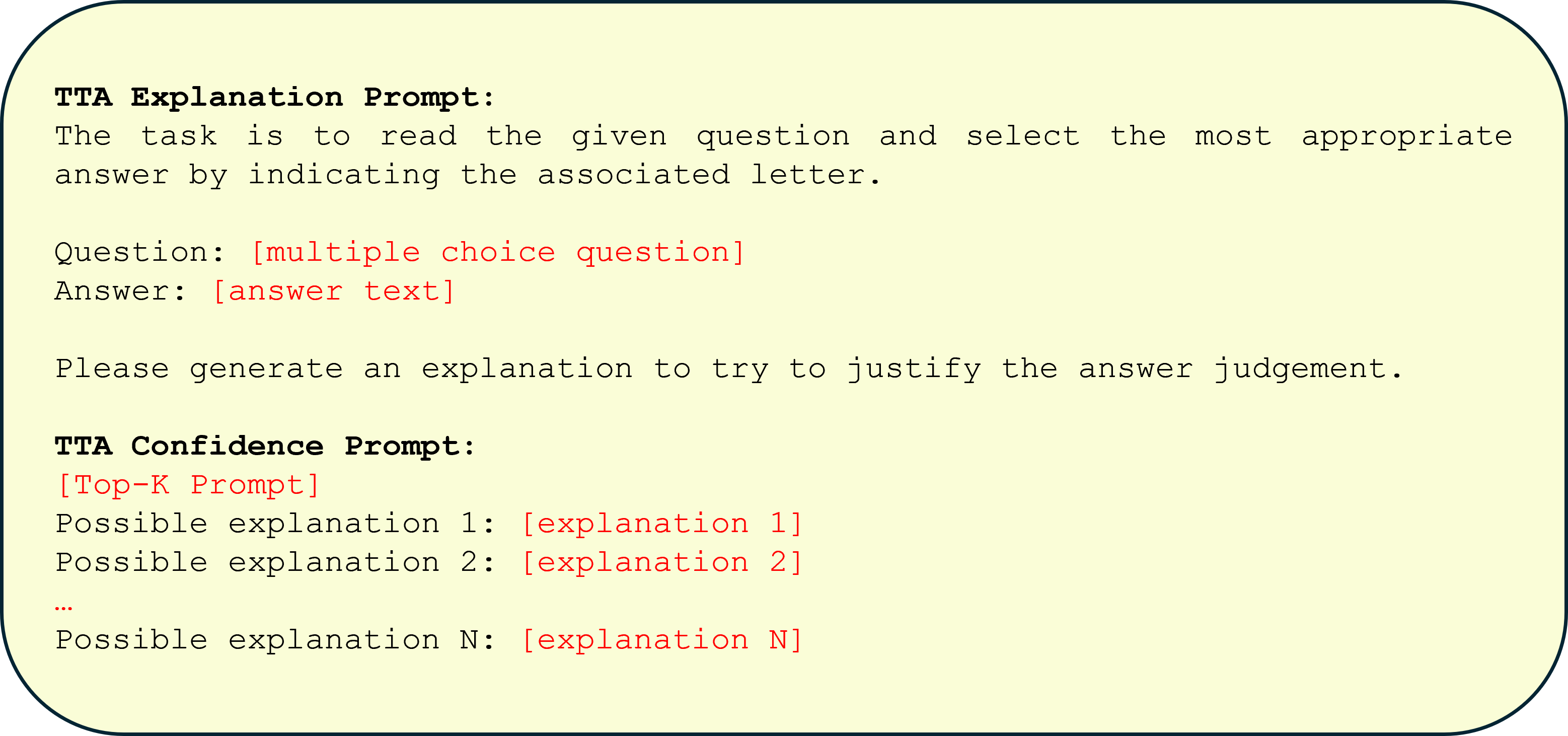
The image presents a structured prompt template for a Task-Specific Text-to-Answer (TTA) system. It outlines two distinct prompts: an "Explanation Prompt" and a "Confidence Prompt," detailing their purpose and expected input/output format. The background is a pale yellow.
### Components/Axes
The document is divided into two main sections, visually separated by rounded rectangles with dark grey borders.
* **TTA Explanation Prompt:** This section describes the task of selecting the best answer to a multiple-choice question and providing a justification.
* **TTA Confidence Prompt:** This section details a prompt for generating multiple possible explanations with associated confidence levels.
The following placeholders are present within the prompts:
* `[multiple choice question]`
* `[answer text]`
* `[explanation 1]` through `[explanation N]`
* `[Top-K Prompt]`
### Detailed Analysis or Content Details
**TTA Explanation Prompt:**
The text reads:
"TTA Explanation Prompt:
The task is to read the given question and select the most appropriate answer by indicating the associated letter.
Question: [multiple choice question]
Answer: [answer text]
Please generate an explanation to try to justify the answer judgement."
**TTA Confidence Prompt:**
The text reads:
"TTA Confidence Prompt:
[Top-K Prompt]
Possible explanation 1: [explanation 1]
Possible explanation 2: [explanation 2]
...
Possible explanation N: [explanation N]"
The ellipsis (...) indicates that the "Possible explanation" lines can be repeated for a variable number of explanations (N).
### Key Observations
The document is a template, relying heavily on placeholders. It's designed to guide the creation of prompts for a system that not only answers questions but also explains *why* it chose that answer, and potentially provides multiple explanations with varying degrees of confidence. The use of brackets `[]` consistently denotes placeholders for dynamic content.
### Interpretation
This document outlines a sophisticated approach to question answering. It moves beyond simply providing a correct answer and emphasizes the importance of explainability and confidence estimation. The "Explanation Prompt" aims to elicit a rationale for the chosen answer, while the "Confidence Prompt" explores multiple possible justifications and implicitly suggests a mechanism for ranking them. This structure is likely intended for building more robust and trustworthy AI systems, where understanding the reasoning behind a decision is as important as the decision itself. The "Top-K Prompt" suggests a method for generating a set of candidate explanations, which could then be evaluated based on various criteria (e.g., coherence, relevance, plausibility). The template is a blueprint for a system designed to mimic human-like reasoning and justification.