## Screenshot: TTA Prompt Template for Multiple-Choice Questions
### Overview
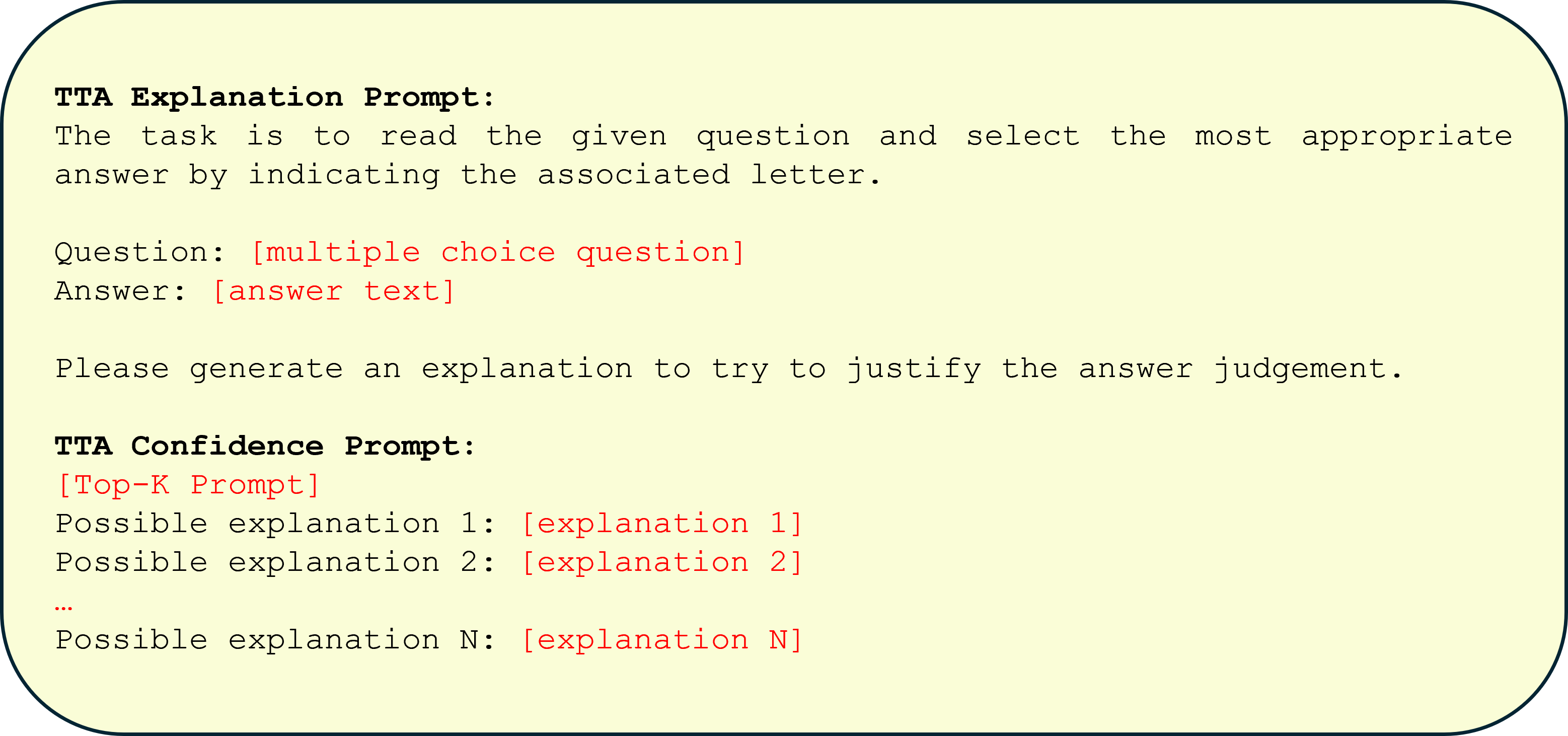
The image displays a structured template for generating explanations and confidence assessments for multiple-choice questions. It includes placeholders for question/answer content and instructions for generating justifications.
### Components/Axes
- **Headings**:
- `TTA Explanation Prompt:`
- `TTA Confidence Prompt:`
- **Placeholders**:
- `[multiple choice question]`
- `[answer text]`
- `[Top-K Prompt]`
- `[explanation 1]` to `[explanation N]`
- **Instructions**:
- "The task is to read the given question and select the most appropriate answer by indicating the associated letter."
- "Please generate an explanation to try to justify the answer judgement."
### Detailed Analysis
- **TTA Explanation Prompt Section**:
- Contains a question placeholder (`[multiple choice question]`) and an answer placeholder (`[answer text]`).
- Directs the user to generate an explanation justifying the answer.
- **TTA Confidence Prompt Section**:
- Includes a `[Top-K Prompt]` placeholder.
- Lists `N` possible explanations (`[explanation 1]` to `[explanation N]`), suggesting iterative refinement or confidence scoring.
### Key Observations
- Placeholders are marked in red brackets, indicating editable fields.
- The template emphasizes **justification** (`"justify the answer judgement"`) and **confidence assessment** (`"Top-K Prompt"`).
- No numerical data or visual trends are present; the focus is on textual structure and workflow.
### Interpretation
This template is designed for **iterative reasoning** in question-answering systems. The `TTA Explanation Prompt` ensures answers are supported by logical reasoning, while the `TTA Confidence Prompt` allows for evaluating multiple explanations to gauge confidence (e.g., via Top-K sampling). The absence of numerical data suggests it is a **procedural guide** rather than a data visualization. The use of `[explanation N]` implies scalability for handling varying levels of confidence or alternative reasoning paths.