## Flow Diagram: Clingo Program Stages
### Overview
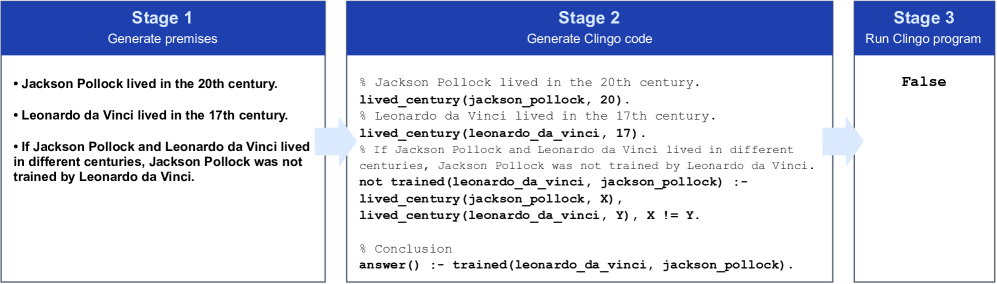
The image is a flow diagram illustrating the three stages of a Clingo program. The stages are: Generate premises, Generate Clingo code, and Run Clingo program. Each stage is represented in a separate rectangular box, with arrows indicating the flow of the process.
### Components/Axes
* **Stage 1:**
* Title: Stage 1
* Subtitle: Generate premises
* Content:
* Jackson Pollock lived in the 20th century.
* Leonardo da Vinci lived in the 17th century.
* If Jackson Pollock and Leonardo da Vinci lived in different centuries, Jackson Pollock was not trained by Leonardo da Vinci.
* **Stage 2:**
* Title: Stage 2
* Subtitle: Generate Clingo code
* Content:
* `% Jackson Pollock lived in the 20th century.`
* `lived_century(jackson_pollock, 20).`
* `% Leonardo da Vinci lived in the 17th century.`
* `lived_century(leonardo_da_vinci, 17).`
* `% If Jackson Pollock and Leonardo da Vinci lived in different centuries, Jackson Pollock was not trained by Leonardo da Vinci.`
* `not trained(leonardo_da_vinci, jackson_pollock) :-`
* `lived_century(jackson_pollock, X),`
* `lived_century(leonardo_da_vinci, Y), X != Y.`
* `% Conclusion`
* `answer() :- trained(leonardo_da_vinci, jackson_pollock).`
* **Stage 3:**
* Title: Stage 3
* Subtitle: Run Clingo program
* Content:
* `False`
* **Flow Arrows:** Arrows indicate the flow from Stage 1 to Stage 2, and from Stage 2 to Stage 3.
### Detailed Analysis or ### Content Details
* **Stage 1 (Generate premises):** This stage lists three premises: Jackson Pollock lived in the 20th century, Leonardo da Vinci lived in the 17th century, and a conditional statement about training based on the centuries they lived in.
* **Stage 2 (Generate Clingo code):** This stage translates the premises into Clingo code. It includes facts about the centuries in which Jackson Pollock and Leonardo da Vinci lived, a rule stating that if they lived in different centuries, Jackson Pollock was not trained by Leonardo da Vinci, and a conclusion that attempts to infer that Leonardo da Vinci trained Jackson Pollock.
* **Stage 3 (Run Clingo program):** This stage shows the result of running the Clingo program, which is "False".
### Key Observations
* The Clingo program aims to determine if Leonardo da Vinci trained Jackson Pollock based on the given premises.
* The Clingo code includes comments (lines starting with `%`) that explain the purpose of each line of code.
* The rule `not trained(leonardo_da_vinci, jackson_pollock) :- lived_century(jackson_pollock, X), lived_century(leonardo_da_vinci, Y), X != Y.` encodes the conditional statement from Stage 1.
* The conclusion `answer() :- trained(leonardo_da_vinci, jackson_pollock).` attempts to derive that Leonardo da Vinci trained Jackson Pollock.
* The final result "False" indicates that the Clingo program could not prove that Leonardo da Vinci trained Jackson Pollock based on the given premises and rules.
### Interpretation
The diagram illustrates a simple example of using Clingo, an answer set programming system, to reason about facts and rules. The program attempts to determine if Leonardo da Vinci trained Jackson Pollock based on their respective centuries of existence. The result "False" suggests that the provided premises and rules do not allow the program to conclude that Leonardo da Vinci trained Jackson Pollock. This could be because the premises are insufficient, or because the rules are not formulated in a way that allows the program to derive the desired conclusion. The example demonstrates how Clingo can be used to encode knowledge and reason about it in a logical manner.
```