\n
## Diagram: Logic Programming Workflow
### Overview
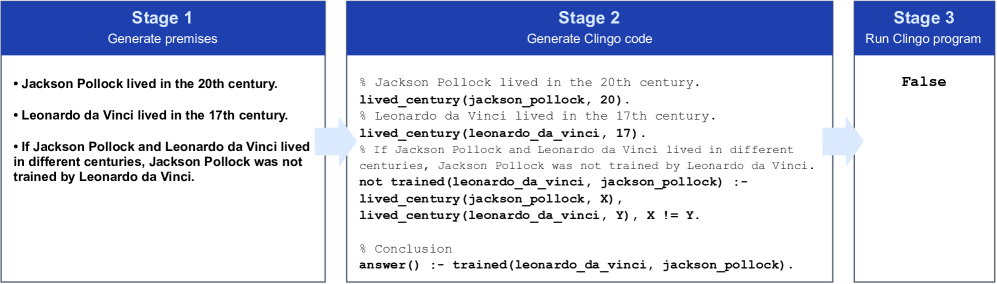
The image depicts a three-stage workflow for logic programming, specifically using a system called Clingo. The stages are: generating premises, generating Clingo code, and running the Clingo program. The diagram illustrates how a set of natural language premises is translated into Clingo code and then evaluated to produce a result.
### Components/Axes
The diagram is divided into three rectangular stages, labeled "Stage 1", "Stage 2", and "Stage 3" from left to right. Each stage has a blue background. An arrow connects Stage 2 to Stage 3, indicating the flow of information.
* **Stage 1 (Generate premises):** Contains a bulleted list of premises.
* **Stage 2 (Generate Clingo code):** Contains a block of Clingo code.
* **Stage 3 (Run Clingo program):** Displays the result of running the Clingo program, which is "False".
### Detailed Analysis or Content Details
**Stage 1: Generate Premises**
* "Jackson Pollock lived in the 20th century."
* "Leonardo da Vinci lived in the 17th century."
* "If Jackson Pollock and Leonardo da Vinci lived in different centuries, Jackson Pollock was not trained by Leonardo da Vinci."
**Stage 2: Generate Clingo code**
The Clingo code block contains the following:
```clingo
% Jackson Pollock lived in the 20th century.
lived_century(jackson_pollock, 20).
% Leonardo da Vinci lived in the 17th century.
lived_century(leonardo_da_vinci, 17).
% If Jackson Pollock and Leonardo da Vinci lived in different centuries, Jackson Pollock was not trained by Leonardo da Vinci.
not trained(leonardo_da_vinci, jackson_pollock) :-
lived_century(jackson_pollock, X),
lived_century(leonardo_da_vinci, Y), X != Y.
% Conclusion
answer() :- trained(leonardo_da_vinci, jackson_pollock).
```
**Stage 3: Run Clingo program**
The result of running the Clingo program is: "False".
### Key Observations
The diagram demonstrates a logical deduction process. The premises are converted into a formal representation (Clingo code) and then evaluated. The result "False" indicates that, based on the given premises and the Clingo code, the conclusion that Leonardo da Vinci trained Jackson Pollock is not supported.
### Interpretation
This diagram illustrates a simple example of automated reasoning. The system takes natural language statements, translates them into a logical form, and uses a solver (Clingo) to determine the truth or falsity of a conclusion. The fact that the result is "False" suggests that the premises, when formalized, do not logically imply that Leonardo da Vinci trained Jackson Pollock. This is consistent with historical knowledge, as they lived in different centuries. The diagram highlights the power of logic programming to perform automated reasoning and verify conclusions based on a set of premises. The use of Clingo suggests a specific implementation of Answer Set Programming (ASP), a declarative programming paradigm. The diagram is a pedagogical tool to explain the process of converting natural language into a formal logical representation and then using a solver to derive conclusions.