## Process Diagram: Logical Reasoning Workflow via Clingo
### Overview
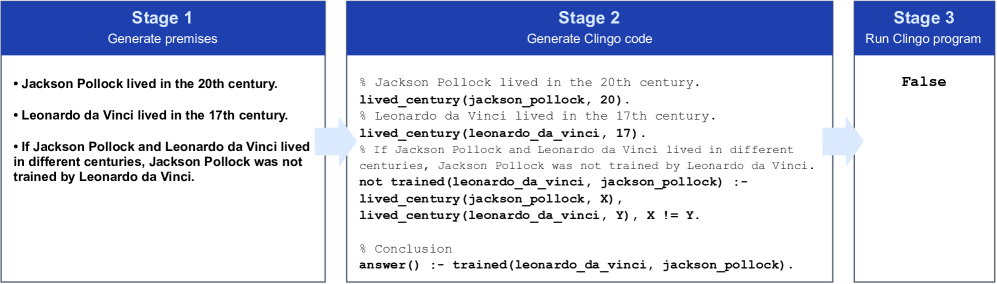
The image displays a three-stage horizontal flowchart illustrating a logical reasoning process. It demonstrates how natural language premises about historical figures are translated into a formal logic program (Clingo code) and then executed to derive a conclusion. The process flows from left to right, indicated by light blue arrows connecting the stages.
### Components/Axes
The diagram is segmented into three distinct rectangular boxes, each with a dark blue header bar containing white text.
1. **Stage 1 (Left Box):**
* **Header:** "Stage 1" / "Generate premises"
* **Content:** A list of three bulleted statements in natural English.
2. **Stage 2 (Center Box):**
* **Header:** "Stage 2" / "Generate Clingo code"
* **Content:** A block of Clingo (Answer Set Programming) code, including comments (lines starting with `%`) and logic rules.
3. **Stage 3 (Right Box):**
* **Header:** "Stage 3" / "Run Clingo program"
* **Content:** The single word "False" in bold, representing the program's output.
### Detailed Analysis
**Stage 1: Generate premises**
The input consists of three natural language statements:
* "Jackson Pollock lived in the 20th century."
* "Leonardo da Vinci lived in the 17th century."
* "If Jackson Pollock and Leonardo da Vinci lived in different centuries, Jackson Pollock was not trained by Leonardo da Vinci."
**Stage 2: Generate Clingo code**
The natural language premises are translated into formal Clingo syntax. The code is structured as follows:
* **Facts:**
* `% Jackson Pollock lived in the 20th century.` (Comment)
* `lived_century(jackson_pollock, 20).`
* `% Leonardo da Vinci lived in the 17th century.` (Comment)
* `lived_century(leonardo_da_vinci, 17).`
* **Rule:**
* `% If Jackson Pollock and Leonardo da Vinci lived in different centuries, Jackson Pollock was not trained by Leonardo da Vinci.` (Comment)
* `not trained(leonardo_da_vinci, jackson_pollock) :-`
* ` lived_century(jackson_pollock, X),`
* ` lived_century(leonardo_da_vinci, Y), X != Y.`
* **Conclusion Query:**
* `% Conclusion` (Comment)
* `answer() :- trained(leonardo_da_vinci, jackson_pollock).`
**Stage 3: Run Clingo program**
The execution of the Clingo program defined in Stage 2 yields the result: **False**.
### Key Observations
1. **Logical Translation:** The process accurately converts temporal facts ("lived in the Xth century") into predicate logic (`lived_century(person, century)`).
2. **Rule Formulation:** The conditional statement ("If... then...") is correctly encoded as a constraint rule (`:-`) in Clingo. The rule states that the `trained` relationship is *not* true if the centuries are different (`X != Y`).
3. **Conclusion Check:** The final `answer()` predicate is defined to be true only if `trained(leonardo_da_vinci, jackson_pollock)` is true. The program's output of "False" indicates this predicate could not be satisfied.
4. **Data Consistency:** The centuries provided (20 and 17) satisfy the condition `X != Y` in the rule, thereby activating the `not trained(...)` constraint.
### Interpretation
This diagram serves as a concrete example of **automated logical reasoning**. It shows the pipeline from human knowledge representation to machine verification.
* **What the data suggests:** The system is testing the hypothesis "Leonardo da Vinci trained Jackson Pollock." Given the premises that they lived centuries apart and that such a temporal gap precludes a training relationship, the logical engine correctly concludes the hypothesis is **false**.
* **How elements relate:** The stages represent a transformation chain: **Natural Language -> Formal Logic -> Computed Truth Value**. The arrows signify the flow of information and the increasing formality of representation.
* **Notable patterns/anomalies:** The key insight is the encoding of *common sense* (a person cannot train someone who lived centuries later) into a strict logical rule. The "False" result is not a failure but a successful validation of logical consistency based on the given axioms. The diagram effectively demystifies how symbolic AI systems process and reason over factual knowledge.