## Flowchart: Logical Reasoning Process to Determine Training Relationship
### Overview
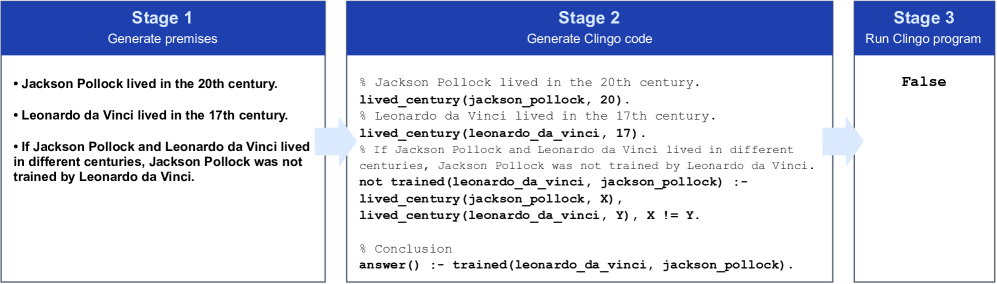
The image depicts a three-stage flowchart illustrating how to use logical reasoning and Clingo (a logic programming tool) to determine whether Jackson Pollock was trained by Leonardo da Vinci. The stages progress from premise generation to code execution and result interpretation.
### Components/Axes
1. **Stage 1: Generate Premises**
- Textual premises:
- "Jackson Pollock lived in the 20th century."
- "Leonardo da Vinci lived in the 17th century."
- Conditional statement: "If Jackson Pollock and Leonardo da Vinci lived in different centuries, Jackson Pollock was not trained by Leonardo da Vinci."
2. **Stage 2: Generate Clingo Code**
- Code structure:
- Facts:
- `lived_century(jackson_pollock, 20).`
- `lived_century(leonardo_da_vinci, 17).`
- Rule:
- `not trained(leonardo_da_vinci, jackson_pollock) :- lived_century(jackson_pollock, X), lived_century(leonardo_da_vinci, Y), X != Y.`
- Conclusion query:
- `answer() :- trained(leonardo_da_vinci, jackson_pollock).`
3. **Stage 3: Run Clingo Program**
- Output: `False` (indicating the conclusion does not hold).
### Detailed Analysis
- **Stage 1**: Establishes historical facts about the lifetimes of Jackson Pollock (20th century) and Leonardo da Vinci (17th century). The conditional premise explicitly links non-overlapping lifetimes to the absence of a training relationship.
- **Stage 2**: Translates premises into Clingo syntax:
- Facts encode their lifetimes.
- The rule uses negation-as-failure (`not trained(...)`) to assert that training is impossible if their lifetimes differ.
- The `answer()` query seeks confirmation of the training relationship.
- **Stage 3**: The result `False` confirms that the training relationship is invalid under the given premises.
### Key Observations
- The logical flow is linear: premises → code → result.
- The Clingo code uses **negation-as-failure** to model the conditional premise.
- The conclusion directly queries the training relationship, which the code disproves due to non-overlapping lifetimes.
### Interpretation
The flowchart demonstrates how formal logic and programming can validate historical claims. By encoding premises into Clingo, the system deduces that Jackson Pollock could not have been trained by Leonardo da Vinci, as their lifetimes do not overlap. This highlights the power of computational logic in resolving factual disputes.
No numerical data, trends, or anomalies are present, as the image focuses on textual and code-based reasoning.