TECHNICAL ASSET FINGERPRINT
92e7547b633e65be3ee4d5a9
Click to view fullscreen
Press ESC or click to close
FOUND IN PAPERS
EXPERT: healer-alpha-free VERSION 1
RUNTIME: free/openrouter/healer-alpha
INTEL_VERIFIED
## Heatmap Series: Trust Matrices in Game Theory Scenarios
### Overview
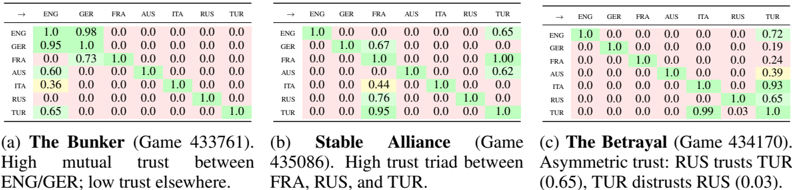
The image displays three separate heatmap visualizations, each representing a "trust matrix" between different national entities (abbreviated as three-letter codes) within distinct game theory scenarios. The heatmaps use a color gradient from green (high trust, value 1.0) to red (low trust, value 0.0) to illustrate the level of trust one entity has for another. Each heatmap is accompanied by a title and a brief descriptive caption.
### Components/Axes
* **Chart Type:** Three separate Heatmaps (a, b, c).
* **Row & Column Labels (Identical for all three):** The matrices are 8x8. The rows and columns are labeled with the same set of country abbreviations in the same order:
* `ENG` (England)
* `GER` (Germany)
* `FRA` (France)
* `AUS` (Austria)
* `ITA` (Italy)
* `RUS` (Russia)
* `TUR` (Turkey)
* **Data Values:** Each cell contains a numerical value between 0.0 and 1.0, representing the trust score from the row entity to the column entity.
* **Color Scale:** Implicitly defined by the cell colors:
* **Green shades:** Indicate higher trust values (closer to 1.0).
* **Red shades:** Indicate lower trust values (closer to 0.0).
* **White/Neutral:** Indicates a value of 0.0 (complete lack of trust).
* **Spatial Layout:** The three heatmaps are arranged horizontally in a single row, labeled (a), (b), and (c) from left to right. Each has a title and descriptive text centered below it.
### Detailed Analysis
#### **(a) The Bunker (Game 433761)**
* **Title & Caption:** "The Bunker (Game 433761). High mutual trust between ENG/GER; low trust elsewhere."
* **Data Extraction & Trend Verification:**
* **High Trust Cluster:** The only strong, mutual trust relationship is between `ENG` and `GER`.
* `ENG` → `GER`: **0.98** (Green)
* `GER` → `ENG`: **0.95** (Green)
* **Moderate/One-Sided Trust:**
* `ENG` → `AUS`: **0.60** (Light Green)
* `ITA` → `ENG`: **0.36** (Light Red/Pink)
* `TUR` → `ENG`: **0.65** (Light Green)
* **Low/No Trust:** All other cells, including the entire lower-left triangle (e.g., `GER` → `FRA`, `FRA` → `GER`) and most of the upper-right triangle, are **0.0** (Red/White). This indicates a near-total absence of trust outside the ENG-GER dyad.
* **Key Pattern:** Trust is almost exclusively confined to a single, strong bilateral relationship (`ENG`-`GER`). The rest of the network is characterized by distrust.
#### **(b) Stable Alliance (Game 435086)**
* **Title & Caption:** "Stable Alliance (Game 435086). High trust triad between FRA, RUS, and TUR."
* **Data Extraction & Trend Verification:**
* **High Trust Triad:** A strong, mutually trusting alliance exists between `FRA`, `RUS`, and `TUR`.
* `FRA` → `RUS`: **1.00** (Bright Green)
* `RUS` → `FRA`: **0.76** (Green)
* `RUS` → `TUR`: **0.95** (Bright Green)
* `TUR` → `RUS`: **1.00** (Bright Green)
* `FRA` → `TUR`: **0.0** (Red) - *Note: This is a notable asymmetry within the triad.*
* `TUR` → `FRA`: **0.0** (Red)
* **Other Notable Trust:**
* `GER` → `ENG`: **1.00** (Bright Green) - *A separate, strong one-way trust.*
* `GER` → `FRA`: **0.67** (Light Green)
* `ITA` → `AUS`: **1.00** (Bright Green) - *Another separate, strong one-way trust.*
* `AUS` → `ITA`: **0.62** (Light Green)
* **Low/No Trust:** Many cells, particularly those involving `ENG`, `GER`, `AUS`, and `ITA` towards the `FRA`/`RUS`/`TUR` bloc, are **0.0**.
* **Key Pattern:** The network features a core triad of high mutual trust (`RUS`↔`TUR`, `FRA`→`RUS`), but it is not fully reciprocal (`FRA`↔`TUR` is 0.0). Other strong, isolated trust pairs exist (`GER`→`ENG`, `ITA`→`AUS`).
#### **(c) The Betrayal (Game 434170)**
* **Title & Caption:** "The Betrayal (Game 434170). Asymmetric trust: RUS trusts TUR (0.65), TUR distrusts RUS (0.03)."
* **Data Extraction & Trend Verification:**
* **Asymmetric Trust (Key Feature):** The most striking feature is the severe asymmetry between `RUS` and `TUR`.
* `RUS` → `TUR`: **0.65** (Light Green) - *Moderate trust.*
* `TUR` → `RUS`: **0.03** (Red) - *Near-total distrust.*
* **Other High Trust Values:**
* `ENG` → `GER`: **1.00** (Bright Green)
* `GER` → `ENG`: **0.72** (Green)
* `ITA` → `RUS`: **0.93** (Bright Green)
* `RUS` → `ITA`: **0.65** (Light Green)
* `TUR` → `ITA`: **0.99** (Bright Green)
* **Low/No Trust:** Significant distrust is present, e.g., `FRA` trusts no one (all outgoing values are **0.0**), and `AUS` is trusted by few.
* **Key Pattern:** Trust is highly uneven and asymmetric. The central narrative is the one-sided trust from `RUS` to `TUR`, which is not reciprocated, justifying the title "The Betrayal." Other strong trust lines exist but are often one-directional.
### Key Observations
1. **Diagonal Values:** In all three matrices, the diagonal cells (e.g., `ENG`→`ENG`, `GER`→`GER`) are **1.0** (bright green), indicating perfect self-trust, which is a standard assumption in such models.
2. **Color-Value Consistency:** The color coding consistently matches the numerical values: values ≥0.9 are bright green, values around 0.5-0.7 are light green/pink, and values ≤0.1 are red.
3. **Network Structure Evolution:** The three games show different network topologies:
* (a) **Isolated Dyad:** One strong pair, everyone else disconnected.
* (b) **Core-Periphery with Clusters:** A central triad and separate pairs.
* (c) **Complex Asymmetry:** Multiple one-way trust lines and a central betrayal dynamic.
4. **Zero-Trust Blocs:** In each game, specific groups of players exhibit near-zero mutual trust (e.g., everyone except ENG/GER in (a); FRA/RUS/TUR vs. others in parts of (b)).
### Interpretation
These heatmaps are not just data visualizations; they are **strategic narratives**. Each represents a possible state of international relations within a game (likely a variant of Diplomacy or a similar negotiation game).
* **What the data suggests:** The matrices quantify the "social landscape" of the game. High trust enables cooperation, information sharing, and stable alliances. Low trust or asymmetry predicts conflict, betrayal, and fragile agreements.
* **How elements relate:** The trust from Player A to Player B is independent of the reverse direction, allowing for complex relationships like the one-sided trust in "The Betrayal." The overall pattern reveals potential coalition structures (the triad in (b)) and fault lines (the ENG-GER bloc vs. all in (a)).
* **Notable Anomalies:** The complete lack of trust from `FRA` in game (c) is extreme and suggests a player adopting a purely hostile or isolationist strategy. The asymmetry in the `RUS`-`TUR` relationship in (c) is the defining anomaly that drives the game's title and likely its outcome.
* **Peircean Investigative Reading:** These images are **icons** of strategic situations. They don't show the game's moves but the underlying **potential** for cooperation or conflict. A player seeing matrix (a) would know only the ENG-GER alliance is reliable. A player in game (c) would be warned that trusting `TUR` is dangerous, as `TUR` trusts almost no one, especially not `RUS`. The heatmaps transform abstract social dynamics into a concrete, analyzable format, allowing for "reading between the lines" of diplomatic intent.
DECODING INTELLIGENCE...