## Text-Based Contextual Descriptions
### Overview
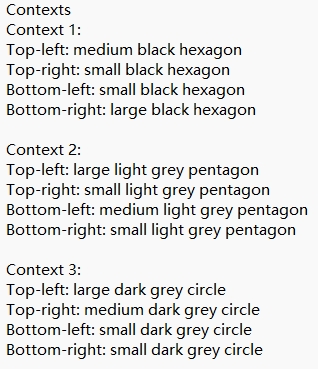
The image contains three distinct contexts (Context 1, Context 2, Context 3), each divided into four quadrants (top-left, top-right, bottom-left, bottom-right). Each quadrant specifies a geometric shape with attributes: size (large, medium, small), color (black, light grey, dark grey), and type (hexagon, pentagon, circle). No numerical data, axes, or legends are present.
### Components/Axes
- **Structure**:
- Three labeled contexts (1, 2, 3).
- Four positional quadrants per context.
- Attributes: Size (large, medium, small), Color (black, light grey, dark grey), Shape (hexagon, pentagon, circle).
### Detailed Analysis
#### Context 1:
- **Top-left**: Medium black hexagon
- **Top-right**: Small black hexagon
- **Bottom-left**: Small black hexagon
- **Bottom-right**: Large black hexagon
#### Context 2:
- **Top-left**: Large light grey pentagon
- **Top-right**: Small light grey pentagon
- **Bottom-left**: Medium light grey pentagon
- **Bottom-right**: Small light grey pentagon
#### Context 3:
- **Top-left**: Large dark grey circle
- **Top-right**: Medium dark grey circle
- **Bottom-left**: Small dark grey circle
- **Bottom-right**: Small dark grey circle
### Key Observations
1. **Repetition of Shapes**:
- Context 1 exclusively uses hexagons.
- Context 2 exclusively uses pentagons.
- Context 3 exclusively uses circles.
2. **Color Consistency**:
- Context 1: All shapes are black.
- Context 2: All shapes are light grey.
- Context 3: All shapes are dark grey.
3. **Size Distribution**:
- **Context 1**: Two small hexagons (top-right, bottom-left), one medium (top-left), one large (bottom-right).
- **Context 2**: Two small pentagons (top-right, bottom-right), one medium (bottom-left), one large (top-left).
- **Context 3**: Three small circles (bottom-left, bottom-right, top-right), one medium (top-right), one large (top-left).
4. **Positional Patterns**:
- Large shapes dominate the **top-left** and **bottom-right** quadrants in Contexts 1 and 2.
- Small shapes cluster in **top-right** and **bottom-left** quadrants across contexts.
### Interpretation
- **Design Intent**: The structured repetition of shapes, sizes, and colors suggests a controlled categorization system, possibly for visual hierarchy or symbolic representation.
- **Spatial Logic**: Larger shapes in diagonal quadrants (top-left/bottom-right) may imply emphasis or focal points, while smaller shapes in adjacent quadrants (top-right/bottom-left) could denote secondary elements.
- **Color Coding**: Monochromatic schemes per context might differentiate categories (e.g., black for "primary," light grey for "secondary," dark grey for "tertiary").
- **Anomalies**: Context 3’s bottom-right quadrant repeats the "small dark grey circle" label, potentially indicating redundancy or an oversight.
This textual structure prioritizes categorical organization over numerical trends, emphasizing spatial and attribute-based relationships.