## Contextual Shape Descriptions
### Overview
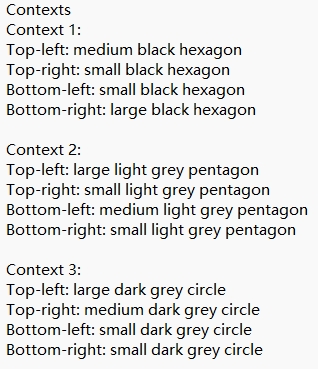
The image presents three distinct contexts, each characterized by a unique shape and color scheme. Each context is further defined by the size and placement of these shapes within a quadrant arrangement (top-left, top-right, bottom-left, bottom-right).
### Components/Axes
* **Context 1:** Black hexagons of varying sizes.
* **Context 2:** Light grey pentagons of varying sizes.
* **Context 3:** Dark grey circles of varying sizes.
### Detailed Analysis or Content Details
* **Context 1:**
* Top-left: Medium black hexagon
* Top-right: Small black hexagon
* Bottom-left: Small black hexagon
* Bottom-right: Large black hexagon
* **Context 2:**
* Top-left: Large light grey pentagon
* Top-right: Small light grey pentagon
* Bottom-left: Medium light grey pentagon
* Bottom-right: Small light grey pentagon
* **Context 3:**
* Top-left: Large dark grey circle
* Top-right: Medium dark grey circle
* Bottom-left: Small dark grey circle
* Bottom-right: Small dark grey circle
### Key Observations
* Each context uses a different shape (hexagon, pentagon, circle) and color (black, light grey, dark grey).
* Within each context, the size of the shape varies, creating a visual hierarchy.
* The arrangement of shapes within each context follows a consistent quadrant structure.
### Interpretation
The image appears to be a visual key or legend defining different contexts based on shape, color, and size. It could be used in a larger document or infographic to represent different categories or variables. The consistent quadrant arrangement suggests a structured approach to data representation, where each position within the quadrant might have a specific meaning. The varying sizes of the shapes likely indicate different magnitudes or levels within each context.