\n
## Textual Description: Contextual Shape Lists
### Overview
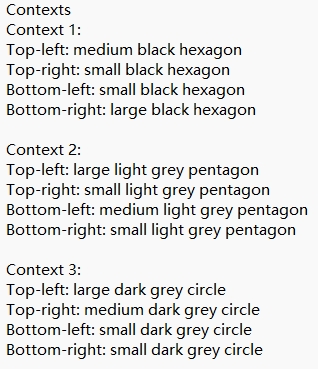
The image presents three distinct lists labeled "Contexts", "Context 1", "Context 2", and "Context 3". Each context describes the arrangement of geometric shapes (hexagons, pentagons, and circles) within a 2x2 grid, specifying their size and color. The information is purely descriptive and does not represent numerical data or a visual chart.
### Components/Axes
The image consists of textual labels and lists. There are no axes or scales. The components are:
* **Title:** "Contexts"
* **Context 1:** A list describing the arrangement of black hexagons.
* **Context 2:** A list describing the arrangement of light grey pentagons.
* **Context 3:** A list describing the arrangement of dark grey circles.
Each context list contains four entries, defining the shape's size ("large", "medium", "small") and position ("Top-left", "Top-right", "Bottom-left", "Bottom-right").
### Detailed Analysis or Content Details
**Context 1: Black Hexagons**
* Top-left: medium black hexagon
* Top-right: small black hexagon
* Bottom-left: small black hexagon
* Bottom-right: large black hexagon
**Context 2: Light Grey Pentagons**
* Top-left: large light grey pentagon
* Top-right: small light grey pentagon
* Bottom-left: medium light grey pentagon
* Bottom-right: small light grey pentagon
**Context 3: Dark Grey Circles**
* Top-left: large dark grey circle
* Top-right: medium dark grey circle
* Bottom-left: small dark grey circle
* Bottom-right: small dark grey circle
### Key Observations
The image provides a series of shape arrangements. Each context uses a different shape and color. The size variations are consistently described as "large", "medium", and "small". The positions are always within a 2x2 grid.
### Interpretation
The image appears to be a set of instructions or examples for arranging shapes. It could be part of a visual puzzle, a design specification, or a test of spatial reasoning. The consistent structure of each context suggests a pattern or rule governing the arrangement of shapes. The use of different shapes and colors in each context might indicate that these are independent examples or variations on a theme. There is no inherent data to analyze beyond the descriptive arrangement of shapes. The image is purely informational and does not demonstrate any trends or anomalies. It is a static description of visual configurations.