## Textual Description: Shape Position and Attribute Matrix
### Overview
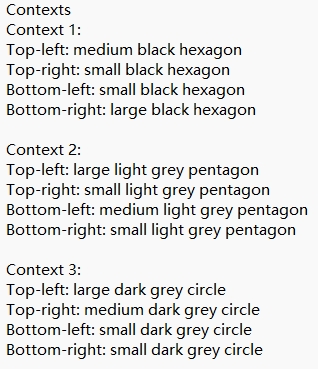
The image contains a structured textual description organized into three distinct "Contexts." Each context defines a set of four geometric shapes, specifying their relative position (top-left, top-right, bottom-left, bottom-right), size, color, and shape type. The text is presented in a plain, list-like format on a white background.
### Components/Axes
The document is structured hierarchically:
- **Primary Headings**: "Contexts" followed by numbered contexts (Context 1, Context 2, Context 3).
- **Positional Labels**: Four fixed positions are used for each context: "Top-left:", "Top-right:", "Bottom-left:", "Bottom-right:".
- **Shape Descriptors**: Each position is followed by a descriptor containing three attributes:
1. **Size**: `small`, `medium`, or `large`.
2. **Color**: `black`, `light grey`, or `dark grey`.
3. **Shape**: `hexagon`, `pentagon`, or `circle`.
### Detailed Analysis / Content Details
The complete textual content is transcribed below. The language is English.
**Context 1:**
* Top-left: medium black hexagon
* Top-right: small black hexagon
* Bottom-left: small black hexagon
* Bottom-right: large black hexagon
**Context 2:**
* Top-left: large light grey pentagon
* Top-right: small light grey pentagon
* Bottom-left: medium light grey pentagon
* Bottom-right: small light grey pentagon
**Context 3:**
* Top-left: large dark grey circle
* Top-right: medium dark grey circle
* Bottom-left: small dark grey circle
* Bottom-right: small dark grey circle
### Key Observations
1. **Consistent Structure**: All three contexts follow an identical template, listing the same four positional coordinates.
2. **Attribute Variation**:
* **Shape**: Each context uses a single, distinct shape type (Context 1: hexagon, Context 2: pentagon, Context 3: circle).
* **Color**: Each context uses a single, distinct color (Context 1: black, Context 2: light grey, Context 3: dark grey).
* **Size**: Size varies within each context across the four positions. The distribution of sizes (small, medium, large) is not uniform between contexts.
3. **Positional Pattern**: There is no immediately obvious repeating pattern in the size distribution across the four positions when comparing contexts. For example, "Top-left" is `medium` in Context 1, `large` in Context 2, and `large` in Context 3.
### Interpretation
This text does not present empirical data or a visual chart. Instead, it is a **specification or a set of rules**. It defines the properties of objects within a defined spatial framework (a 2x2 grid implied by the four corner positions).
* **Purpose**: This could be input data for a programming challenge (e.g., "draw these shapes"), a test for a vision-language model, or a logic puzzle where the goal is to identify the pattern governing the size assignments.
* **Relationship Between Elements**: The elements are related through their shared context. Within a context, all shapes share color and form, differing only in size and position. The primary relationship is the mapping of a unique attribute combination (size, color, shape) to a specific spatial location.
* **Notable Anomalies/Patterns**: The most significant pattern is the **isolation of variables**. Each context changes exactly two variables (color and shape) while holding the positional template constant. The size variable is the only one that changes *within* a context. This structure suggests the information is designed to test comprehension of multi-attribute descriptions and spatial grounding, rather than to convey quantitative trends. The lack of a clear, repeating size pattern across contexts implies the specific size assignments may be arbitrary or part of a larger, unseen sequence.