## Prompt Template: Reasoning MCQA User Prompt Template
### Overview
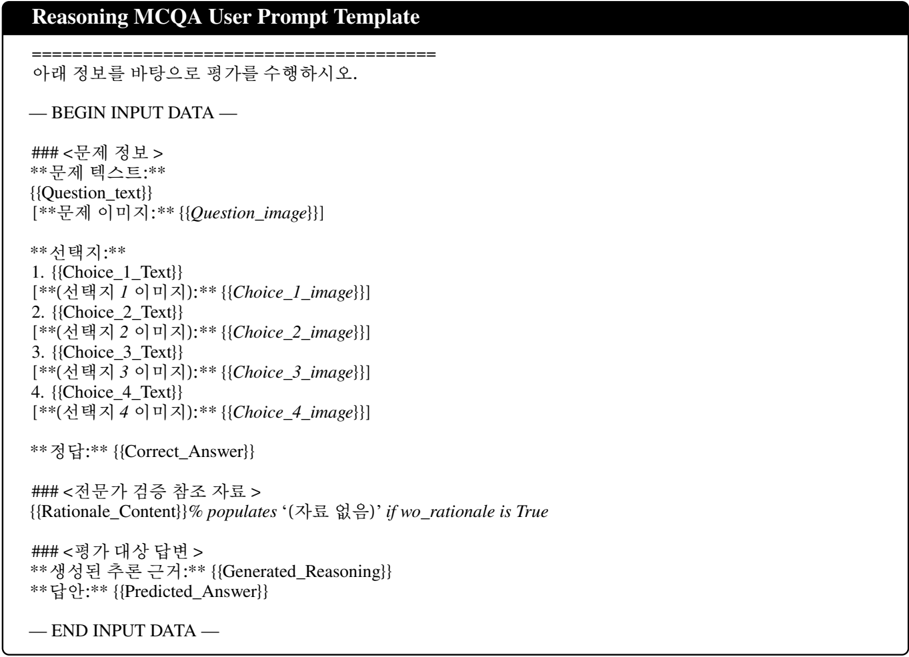
The image depicts a structured template for a multiple-choice question (MCQA) task with reasoning components. It includes placeholders for question text, answer choices, correct answers, rationale content, generated reasoning, and predicted answers. The template is written in **Korean** with embedded English technical terms.
### Components/Axes
#### Header
- **Title**: "Reasoning MCQA User Prompt Template" (English)
- **Korean Subtitle**: "아래 정보를 바탕으로 평가를 수행하시오." (Perform evaluation based on the information below.)
#### Input Data Structure
1. **Question Information** (`문제 정보`):
- `문제 텍스트`: `{{Question_text}}` (Question Text)
- `문제 이미지`: `{{Question_image}}` (Question Image)
2. **Choices** (`선택지`):
- 4 numbered options with text and image placeholders:
- `선택지 1`: `{{Choice_1_Text}}` / `{{Choice_1_image}}`
- `선택지 2`: `{{Choice_2_Text}}` / `{{Choice_2_image}}`
- `선택지 3`: `{{Choice_3_Text}}` / `{{Choice_3_image}}`
- `선택지 4`: `{{Choice_4_Text}}` / `{{Choice_4_image}}`
3. **Correct Answer** (`정답`):
- `{{Correct_Answer}}`
4. **Rationale Content** (`정당성 내용`):
- Conditional logic: `"% populates ‘(자료 없음)’ if wo_rationale is True"`
- `{{Rationale_Content}}`
5. **Generated Reasoning** (`생성된 추론 근거`):
- `{{Generated_Reasoning}}`
6. **Predicted Answer** (`답안`):
- `{{Predicted_Answer}}`
### Content Details
- **Placeholders**: All variables (e.g., `{{Question_text}}`, `{{Choice_1_Text}}`) are enclosed in double curly braces.
- **Conditional Logic**: The rationale content includes a Python-style conditional statement to handle missing data (`'자료 없음'` translates to "No data").
- **Language Mix**: Korean labels with English technical terms (e.g., `wo_rationale`, `populates`).
### Key Observations
- The template is designed for **dynamic input** of MCQA tasks, supporting both text and image-based questions/choices.
- The conditional logic in the rationale section suggests integration with a system that checks for data availability (`wo_rationale`).
- Placeholders are consistent across sections, enabling modular reuse.
### Interpretation
This template facilitates structured reasoning for MCQA tasks by:
1. **Standardizing Input**: Ensuring all required components (question, choices, answer, reasoning) are explicitly defined.
2. **Handling Edge Cases**: The conditional logic in the rationale section addresses scenarios where data might be missing.
3. **Bilingual Design**: Combining Korean instructions with English technical terms implies use in a multilingual or international context (e.g., AI model training/evaluation).
The absence of numerical data or visualizations indicates this is a **text-based template** for guiding input formatting rather than analyzing existing data.