## Network Diagram: Route Comparison
### Overview
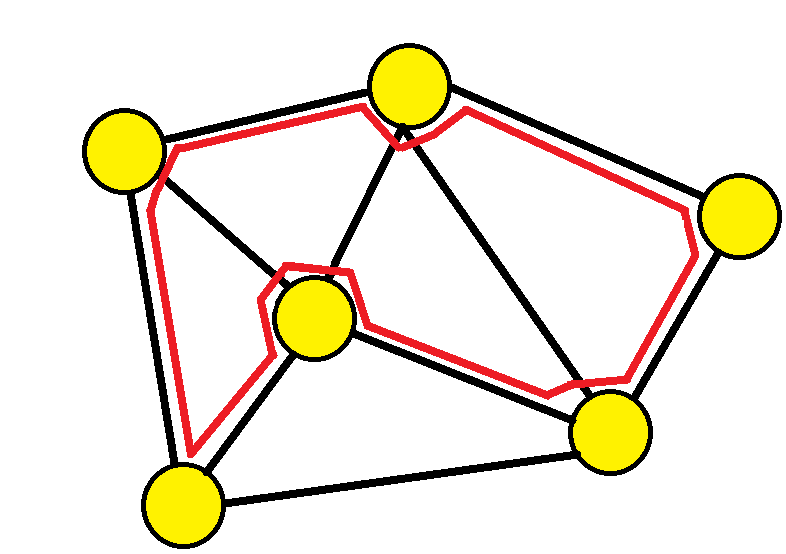
The image depicts a network diagram with six nodes represented by yellow circles. The nodes are interconnected by black lines, representing the original network connections. A red line overlays the network, indicating an alternative route or path through the network.
### Components/Axes
* **Nodes:** Six yellow circles represent the nodes in the network.
* **Original Network Connections:** Black lines connect the nodes, showing the existing network infrastructure.
* **Alternative Route:** A red line traces a path through the network, deviating from the original connections in some areas.
### Detailed Analysis
The network consists of six nodes. The black lines indicate the original connections between these nodes. The red line represents an alternative route through the network.
The red route starts at the bottom-left node, then goes to the top-left node, then to the top-center node, then to the top-right node, then to the bottom-right node, then to the center node, and finally back to the bottom-left node.
The red route deviates from the original black lines in several places. For example, between the top-left and top-center nodes, the red route takes a slightly different path. Similarly, between the top-center and top-right nodes, the red route deviates from the direct black line connection.
### Key Observations
* The red route visits all six nodes in the network.
* The red route is not the shortest path between some nodes, as it deviates from the direct connections.
* The red route forms a closed loop, starting and ending at the same node.
### Interpretation
The diagram likely illustrates a comparison between the original network path and an alternative route. The red route could represent a path with different characteristics, such as lower latency, higher bandwidth, or increased security. The deviations from the original connections suggest that the alternative route may be avoiding certain nodes or links, possibly due to congestion or failure. The fact that the red route visits all nodes indicates that it maintains full network coverage, even with the alternative path.