\n
## Diagram: Cognitive Brain vs. Chain-of-Thought
### Overview
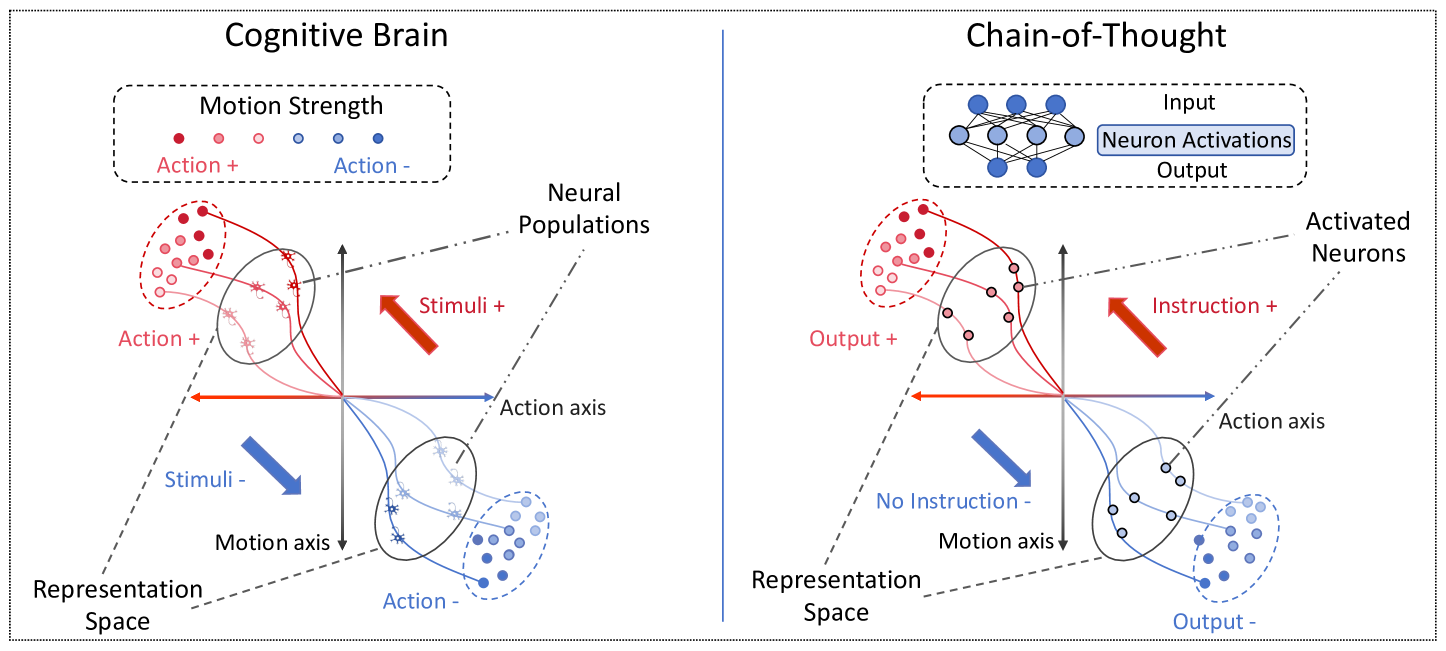
The image presents a comparative diagram illustrating the difference between a "Cognitive Brain" and a "Chain-of-Thought" process. Both sides depict neural populations and representation spaces, but differ in how stimuli and instructions influence activity. The left side represents a more direct stimulus-response mechanism, while the right side shows a more complex, instruction-guided process.
### Components/Axes
The diagram is divided into two main sections: "Cognitive Brain" (left) and "Chain-of-Thought" (right). Each section contains:
* **Representation Space:** A circular area with scattered points representing neural activity.
* **Neural Populations:** Clusters of points within the Representation Space, differentiated by color and shape.
* **Axes:** Two axes are present in each section: "Motion axis" and "Action axis".
* **Stimuli/Instruction:** Red arrows indicating the influence of stimuli (left) or instructions (right).
* **Input/Output:** Labels indicating the flow of information.
* **Top-Left Inset:** A small diagram showing a network of interconnected nodes labeled "Neuron Activations" with "Input" and "Output" labels.
### Detailed Analysis or Content Details
**Cognitive Brain (Left Side):**
* **Motion Strength:** A horizontal row of dots at the top, labeled "Motion Strength", ranging from "Action +" to "Action -".
* **Stimuli +:** A red arrow pointing downwards from the top-center, labeled "Stimuli +". This arrow influences the neural populations in the Representation Space.
* **Stimuli -:** A red arrow pointing downwards from the top-left, labeled "Stimuli -". This arrow also influences the neural populations.
* **Action axis:** A vertical line bisecting the Representation Space.
* **Motion axis:** A horizontal line bisecting the Representation Space.
* **Neural Populations:**
* Top-right: A cluster of red asterisk-shaped points labeled "Action +".
* Bottom-left: A cluster of blue circle-shaped points labeled "Action -".
* Other scattered points of various colors and shapes.
* The arrows "Stimuli +" and "Stimuli -" appear to activate the "Action +" and "Action -" populations respectively.
**Chain-of-Thought (Right Side):**
* **Instruction +:** A red arrow pointing downwards from the top-center, labeled "Instruction +".
* **No Instruction -:** A label indicating the absence of a negative instruction.
* **Action axis:** A vertical line bisecting the Representation Space.
* **Motion axis:** A horizontal line bisecting the Representation Space.
* **Output +:** A label at the bottom-right.
* **Output -:** A label at the bottom-left.
* **Neural Populations:**
* Top-right: A cluster of red circle-shaped points labeled "Output +".
* Bottom-left: A cluster of blue asterisk-shaped points labeled "Output -".
* Other scattered points of various colors and shapes.
* The "Instruction +" arrow influences the neural populations, but the effect appears more nuanced than the direct stimulus in the Cognitive Brain.
* **Top-Left Inset:** A diagram of interconnected nodes, representing a neural network. The nodes are connected by lines, and labeled "Neuron Activations".
### Key Observations
* The "Cognitive Brain" side shows a more direct and immediate response to stimuli.
* The "Chain-of-Thought" side demonstrates a more modulated response, influenced by instructions.
* The neural populations are represented differently in each section, suggesting different types of activity.
* The inset diagram on the right side highlights the complexity of the neural network involved in the Chain-of-Thought process.
* The axes are consistent across both sides, providing a common frame of reference.
### Interpretation
The diagram illustrates a conceptual difference between a basic cognitive response (Cognitive Brain) and a more sophisticated, instruction-driven thought process (Chain-of-Thought). The Cognitive Brain operates on a more direct stimulus-response basis, while the Chain-of-Thought involves a more complex internal representation and modulation of activity based on instructions. The inset diagram suggests that the Chain-of-Thought relies on a network of interconnected neurons, allowing for more flexible and nuanced processing.
The use of arrows to represent stimuli and instructions emphasizes the directional influence on neural activity. The different shapes and colors of the neural populations likely represent different types of neurons or activity patterns. The diagram suggests that the Chain-of-Thought process is more computationally intensive and requires a more complex neural infrastructure than the Cognitive Brain. The labels "Output +" and "Output -" indicate that the Chain-of-Thought process can generate both positive and negative responses, while the Cognitive Brain appears to be more focused on immediate action.
The diagram is a high-level conceptual illustration and does not provide specific quantitative data. However, it effectively conveys the qualitative differences between the two cognitive processes. It suggests that Chain-of-Thought is a more advanced form of cognition that builds upon the basic stimulus-response mechanisms of the Cognitive Brain.