## Line Chart: Epsilon Opt vs. Alpha
### Overview
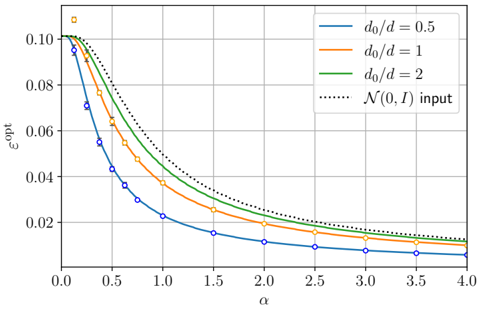
The image is a line chart displaying the relationship between epsilon opt (εopt) on the y-axis and alpha (α) on the x-axis for different values of d0/d. There are four data series represented by different colored lines: blue (d0/d = 0.5), orange (d0/d = 1), green (d0/d = 2), and a black dotted line representing N(0, I) input. The chart shows how epsilon opt decreases as alpha increases for each value of d0/d.
### Components/Axes
* **X-axis:** α (alpha), ranging from 0.0 to 4.0 in increments of 0.5.
* **Y-axis:** εopt (epsilon opt), ranging from 0.00 to 0.10 in increments of 0.02.
* **Legend (Top-Right):**
* Blue line: d0/d = 0.5
* Orange line: d0/d = 1
* Green line: d0/d = 2
* Black dotted line: N(0, I) input
### Detailed Analysis
* **Blue Line (d0/d = 0.5):** This line starts at approximately 0.10 at α = 0.0 and decreases rapidly initially, then plateaus as α increases. Data points are marked with blue circles.
* α = 0.0, εopt ≈ 0.10
* α = 0.5, εopt ≈ 0.04
* α = 1.0, εopt ≈ 0.028
* α = 1.5, εopt ≈ 0.02
* α = 2.0, εopt ≈ 0.015
* α = 2.5, εopt ≈ 0.012
* α = 3.0, εopt ≈ 0.01
* α = 3.5, εopt ≈ 0.008
* α = 4.0, εopt ≈ 0.007
* **Orange Line (d0/d = 1):** This line also starts near 0.10 at α = 0.0 and decreases, but at a slower rate than the blue line. Data points are marked with orange squares.
* α = 0.0, εopt ≈ 0.10
* α = 0.5, εopt ≈ 0.065
* α = 1.0, εopt ≈ 0.04
* α = 1.5, εopt ≈ 0.03
* α = 2.0, εopt ≈ 0.023
* α = 2.5, εopt ≈ 0.019
* α = 3.0, εopt ≈ 0.016
* α = 3.5, εopt ≈ 0.014
* α = 4.0, εopt ≈ 0.012
* **Green Line (d0/d = 2):** This line starts near 0.10 at α = 0.0 and decreases, but at a slower rate than the orange line.
* α = 0.0, εopt ≈ 0.10
* α = 0.5, εopt ≈ 0.08
* α = 1.0, εopt ≈ 0.055
* α = 1.5, εopt ≈ 0.04
* α = 2.0, εopt ≈ 0.03
* α = 2.5, εopt ≈ 0.025
* α = 3.0, εopt ≈ 0.021
* α = 3.5, εopt ≈ 0.018
* α = 4.0, εopt ≈ 0.016
* **Black Dotted Line (N(0, I) input):** This line starts near 0.10 at α = 0.0 and decreases, with a rate between the orange and green lines.
* α = 0.0, εopt ≈ 0.10
* α = 0.5, εopt ≈ 0.085
* α = 1.0, εopt ≈ 0.06
* α = 1.5, εopt ≈ 0.045
* α = 2.0, εopt ≈ 0.035
* α = 2.5, εopt ≈ 0.028
* α = 3.0, εopt ≈ 0.023
* α = 3.5, εopt ≈ 0.019
* α = 4.0, εopt ≈ 0.016
### Key Observations
* As alpha (α) increases, epsilon opt (εopt) decreases for all values of d0/d.
* The rate of decrease in epsilon opt is highest for the blue line (d0/d = 0.5) and lowest for the green line (d0/d = 2).
* The black dotted line (N(0, I) input) falls between the orange (d0/d = 1) and green (d0/d = 2) lines.
* All lines converge towards a similar, low value of epsilon opt as alpha increases towards 4.0.
### Interpretation
The chart illustrates the relationship between alpha (α) and epsilon opt (εopt) for different ratios of d0/d. The data suggests that a smaller d0/d ratio (e.g., 0.5) results in a faster decrease in epsilon opt as alpha increases, indicating a potentially more efficient or sensitive system in this parameter range. Conversely, a larger d0/d ratio (e.g., 2) leads to a slower decrease in epsilon opt, suggesting a less sensitive system. The N(0, I) input serves as a reference, showing a performance level between d0/d = 1 and d0/d = 2. The convergence of all lines at higher alpha values indicates that the impact of d0/d diminishes as alpha becomes sufficiently large.