## Diagram: Knowledge Graph Reasoning Paths
### Overview
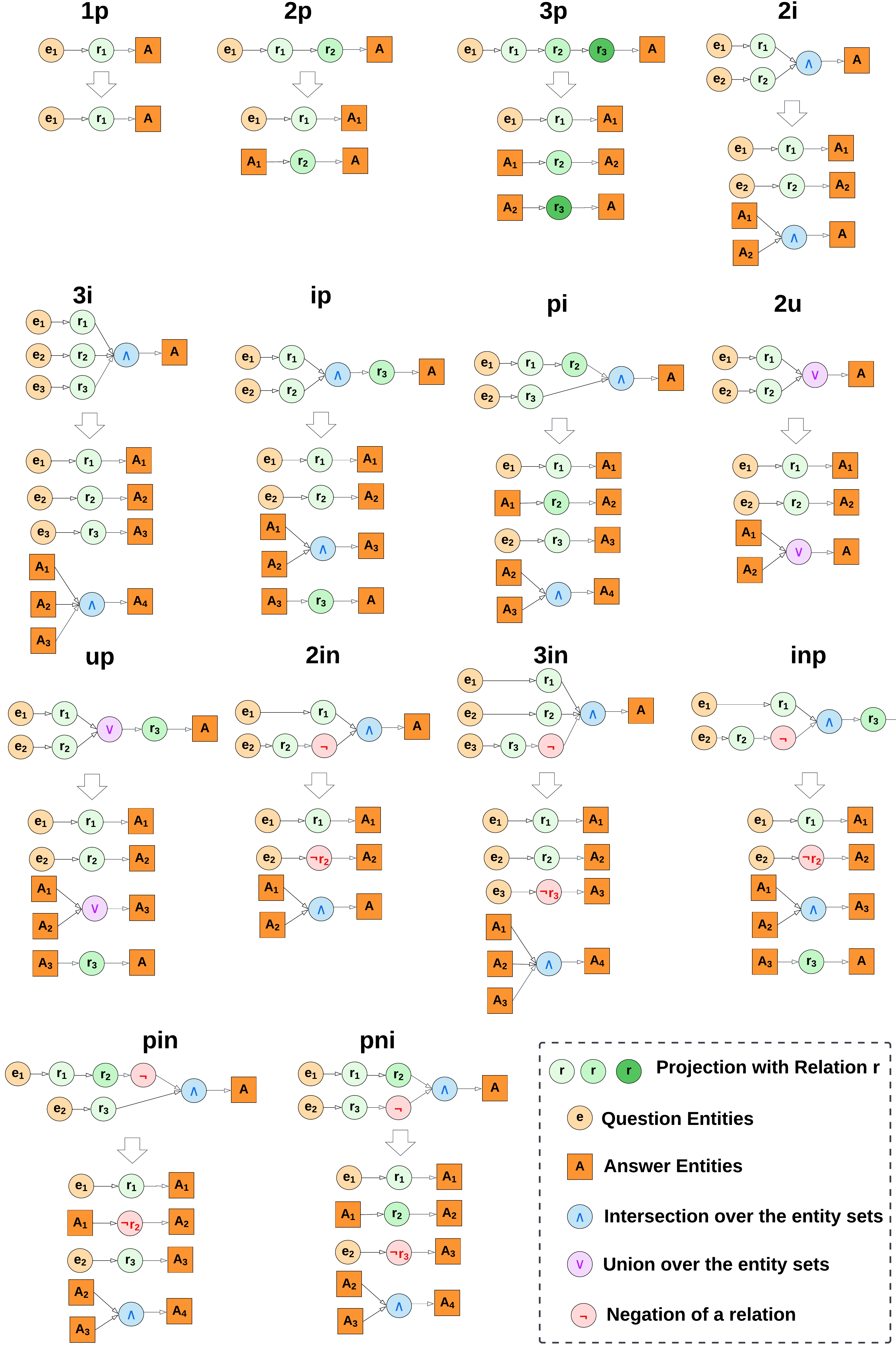
The image presents a series of diagrams illustrating different reasoning paths in knowledge graphs. Each diagram shows how to derive an answer (A) from question entities (e) using relations (r), intersections, unions, and negations. The diagrams are labeled with codes like "1p", "2p", "3i", etc., likely representing different types of reasoning patterns.
### Components/Axes
* **Nodes:**
* Orange circles labeled "e1", "e2", "e3": Represent Question Entities.
* Orange squares labeled "A", "A1", "A2", "A3", "A4": Represent Answer Entities.
* Green circles labeled "r1", "r2", "r3": Represent Relations.
* Light Blue circles with "^": Represent Intersection over the entity sets.
* Pink circles with "V": Represent Union over the entity sets.
* Pink circles with "¬r2", "¬r3": Represent Negation of a relation.
* **Edges:** Arrows indicate the direction of the relation or operation.
* **Layout:** Each reasoning path is shown in two stages, separated by a downward-pointing arrow. The first stage shows the initial entities and relations, and the second stage shows the derived entities and relations.
* **Legend (Bottom-Right):**
* Green circle with "r": Projection with Relation r
* Orange circle with "e": Question Entities
* Orange square with "A": Answer Entities
* Light Blue circle with "^": Intersection over the entity sets
* Pink circle with "V": Union over the entity sets
* Pink circle with "¬": Negation of a relation
### Detailed Analysis
**1p:**
* e1 -> r1 -> A
* After the arrow: e1 -> r1 -> A
**2p:**
* e1 -> r1 -> r2 -> A
* After the arrow: e1 -> r1 -> A1, A1 -> r2 -> A
**3p:**
* e1 -> r1 -> r2 -> r3 -> A
* After the arrow: e1 -> r1 -> A1, A1 -> r2 -> A2, A2 -> r3 -> A
**2i:**
* e1 -> r1 -> ^ -> A
* e2 -> r2 ->
* After the arrow: e1 -> r1 -> A1, e2 -> r2 -> A2, A1 ^ A2 -> A
**3i:**
* e1 -> r1 -> ^ -> A
* e2 -> r2 ->
* e3 -> r3 ->
* After the arrow: e1 -> r1 -> A1, e2 -> r2 -> A2, e3 -> r3 -> A3, A1 ^ A2 ^ A3 -> A4
**ip:**
* e1 -> r1 -> ^ -> r3 -> A
* e2 -> r2 ->
* After the arrow: e1 -> r1 -> A1, e2 -> r2 -> A2, A1 ^ A2 -> r3 -> A
**pi:**
* e1 -> r1 -> r2 -> ^ -> A
* e2 -> r3 ->
* After the arrow: e1 -> r1 -> A1, A1 -> r2 -> A2, e2 -> r3 -> A3, A2 ^ A3 -> A4
**2u:**
* e1 -> r1 -> V -> A
* e2 -> r2 ->
* After the arrow: e1 -> r1 -> A1, e2 -> r2 -> A2, A1 V A2 -> A
**up:**
* e1 -> r1 -> V -> r3 -> A
* e2 -> r2 ->
* After the arrow: e1 -> r1 -> A1, e2 -> r2 -> A2, A1 V A2 -> A3, A3 -> r3 -> A
**2in:**
* e1 -> r1 -> ¬r2 -> ^ -> A
* e2 -> r2 ->
* After the arrow: e1 -> r1 -> A1, e2 -> ¬r2 -> A2, A1 ^ A2 -> A
**3in:**
* e1 -> r1 -> ^ -> A
* e2 -> r2 ->
* e3 -> ¬r3 ->
* After the arrow: e1 -> r1 -> A1, e2 -> r2 -> A2, e3 -> ¬r3 -> A3, A1 ^ A2 ^ A3 -> A4
**inp:**
* e1 -> r1 -> ^ -> r3 -> A
* e2 -> ¬r2 ->
* After the arrow: e1 -> r1 -> A1, e2 -> ¬r2 -> A2, A1 ^ A2 -> r3 -> A
**pin:**
* e1 -> r1 -> r2 -> ¬r3 -> ^ -> A
* e2 -> r3 ->
* After the arrow: e1 -> r1 -> A1, A1 -> r2 -> A2, e2 -> r3 -> A3, A2 ^ A3 -> A4
**pni:**
* e1 -> r1 -> r2 -> ^ -> A
* e2 -> ¬r3 ->
* After the arrow: e1 -> r1 -> A1, A1 -> r2 -> A2, e2 -> ¬r3 -> A3, A2 ^ A3 -> A4
### Key Observations
* The diagrams illustrate various ways to combine entities and relations to infer new entities.
* The use of intersection, union, and negation allows for complex reasoning patterns.
* The "p" in the diagram labels likely stands for "path", "i" for "intersection", "u" for "union", and "n" for "negation".
### Interpretation
The diagrams provide a visual representation of different reasoning strategies in knowledge graphs. They demonstrate how to derive answers to complex queries by combining information from multiple sources and applying logical operations. These patterns are fundamental to knowledge graph reasoning and can be used to develop algorithms for question answering, information retrieval, and other applications. The diagrams highlight the importance of relations, intersections, unions, and negations in knowledge representation and reasoning.