## Diagram: Query Plan Visualizations
### Overview
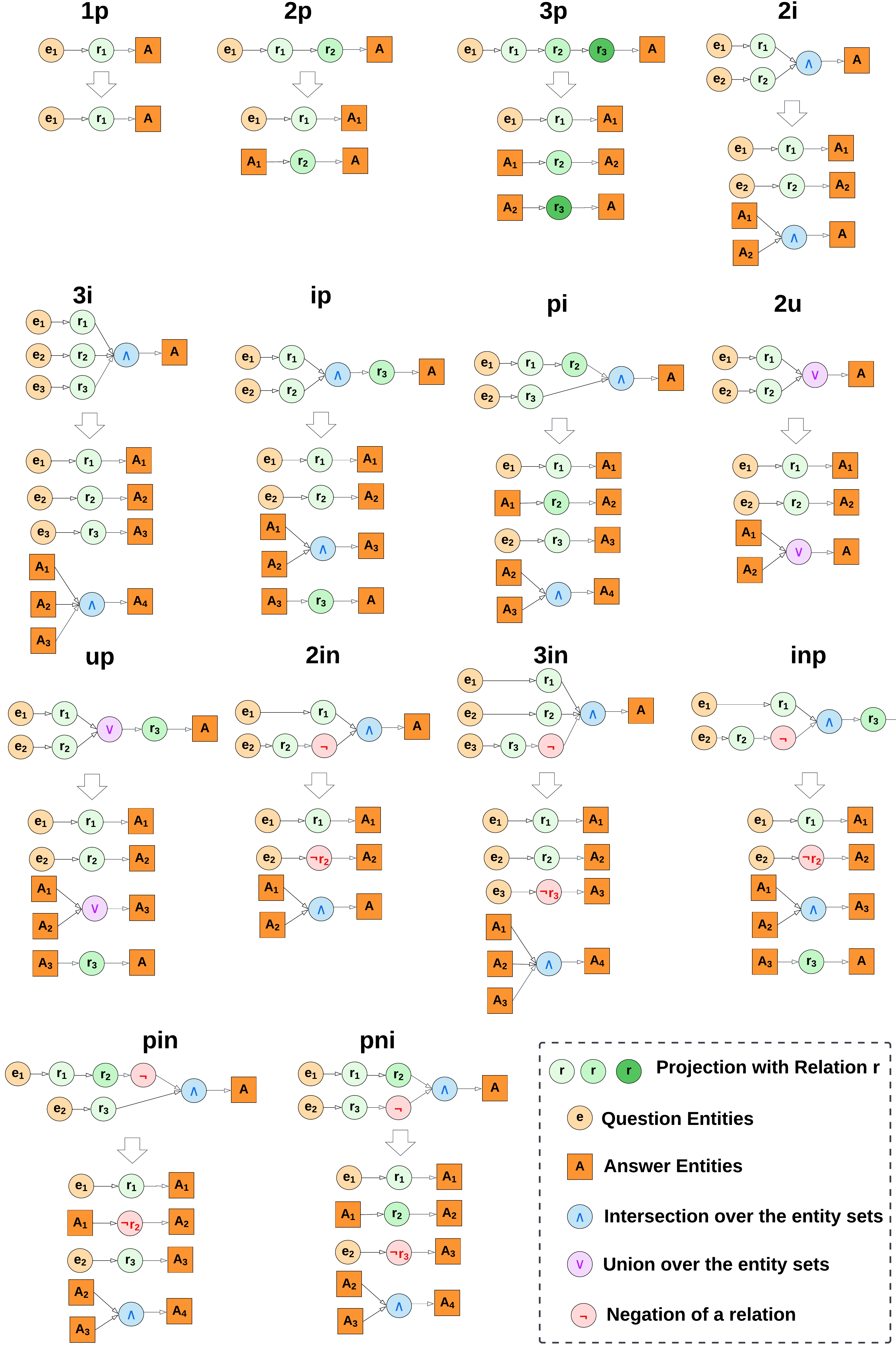
The image presents a grid of 16 diagrams, each representing a query plan visualization. These diagrams depict relationships between entities (e1, e2, e3, f1, f2, f3, A1, A2, A3, A4) and operations performed on them, likely within a database query processing context. Each diagram is labeled with a unique identifier (1p, 2p, 3p, 2i, 3i, ip, pi, 2u, up, 2in, 3in, inp, pin, pni, 2in, 3in). A legend in the bottom-right corner explains the symbols used in the diagrams.
### Components/Axes
The diagrams consist of nodes representing entities and operations, connected by edges indicating relationships or data flow. The legend defines the following symbols:
* **r**: Projection with Relation r
* **e**: Question Entities
* **A**: Answer Entities
* **∩**: Intersection over the entity sets
* **∪**: Union over the entity sets
* **-**: Negation of a relation
The entities involved are: e1, e2, e3, f1, f2, f3, A1, A2, A3, A4.
### Detailed Analysis / Content Details
Each diagram will be described individually, noting the arrangement of entities and operations. Due to the complexity and similarity of the diagrams, I will focus on describing the general patterns and variations.
**1p:** e1 -> f1 -> A. e2 -> f2 -> A.
**2p:** e1 -> f1 -> A. e2 -> f2 -> A.
**3p:** e1 -> f1 -> A1. e2 -> f2 -> A2. e3 -> f3 -> A.
**2i:** e1 -> f1 -> A1. e2 -> f2 -> A.
**3i:** e1 -> f1 -> A1. e2 -> f2 -> A2. e3 -> f3 -> A3.
**ip:** e1 -> f1 -> A1. e2 -> f2 -> A.
**pi:** e1 -> f1 -> A1. e2 -> f2 -> A2. e3 -> f3 -> A3. e4 -> f4 -> A4.
**2u:** e1 -> f1 -> A1. e2 -> f2 -> A.
**up:** e1 -> f1 -> A. e2 -> f2 -> A.
**2in:** e1 -> f1 -> A1. e2 -> f2 -> A2.
**3in:** e1 -> f1 -> A1. e2 -> f2 -> A2. e3 -> f3 -> A3.
**inp:** e1 -> f1 -> A1. e2 -> f2 -> A2. e3 -> f3 -> A3.
**pin:** e1 -> f1 -> A1. e2 -> f2 -> A2.
**pni:** e1 -> f1 -> A1. e2 -> f2 -> A2. e3 -> f3 -> A3. e4 -> f4 -> A4.
**2in:** e1 -> f1 -> A1. e2 -> f2 -> A2.
**3in:** e1 -> f1 -> A1. e2 -> f2 -> A2. e3 -> f3 -> A3.
**Common Patterns:**
* Most diagrams involve a chain of entities (e1, e2, e3) being mapped to entities (f1, f2, f3) and ultimately to answer entities (A, A1, A2, A3, A4).
* The '→' symbol consistently indicates a transformation or mapping between entities.
* The number of entities and answer entities varies between diagrams.
* Some diagrams include intersections (∩) and unions (∪) between entity sets.
* Negation (-) is present in some diagrams.
### Key Observations
* The diagrams demonstrate a progression from question entities to answer entities, likely representing the steps in a query execution plan.
* The complexity of the diagrams varies, with some involving simple mappings and others incorporating set operations.
* The use of different answer entities (A, A1, A2, A3, A4) suggests different levels of granularity or specificity in the query results.
* The diagrams appear to be exploring different ways to combine or filter entities to arrive at the final answer.
### Interpretation
These diagrams likely represent different query plans for the same or similar queries. Each plan outlines a different strategy for retrieving the desired information from a database. The variations in the diagrams reflect different optimization techniques or choices made by the query optimizer.
The presence of set operations (intersection, union, negation) indicates that the queries involve complex filtering or joining of data. The diagrams provide a visual representation of how these operations are applied to the entities involved.
The differences between the plans could be due to factors such as:
* Index availability
* Data distribution
* Query optimizer heuristics
Analyzing these diagrams can help database administrators understand how queries are being executed and identify potential areas for optimization. The diagrams are a form of visual explanation, allowing for a more intuitive understanding of the query processing steps. The diagrams are not providing numerical data, but rather a structural representation of logical operations. They are a visual language for describing query execution.