TECHNICAL ASSET FINGERPRINT
93b9d863d908b9345703ed96
Click to view fullscreen
Press ESC or click to close
FOUND IN PAPERS
EXPERT: healer-alpha-free VERSION 1
RUNTIME: free/openrouter/healer-alpha
INTEL_VERIFIED
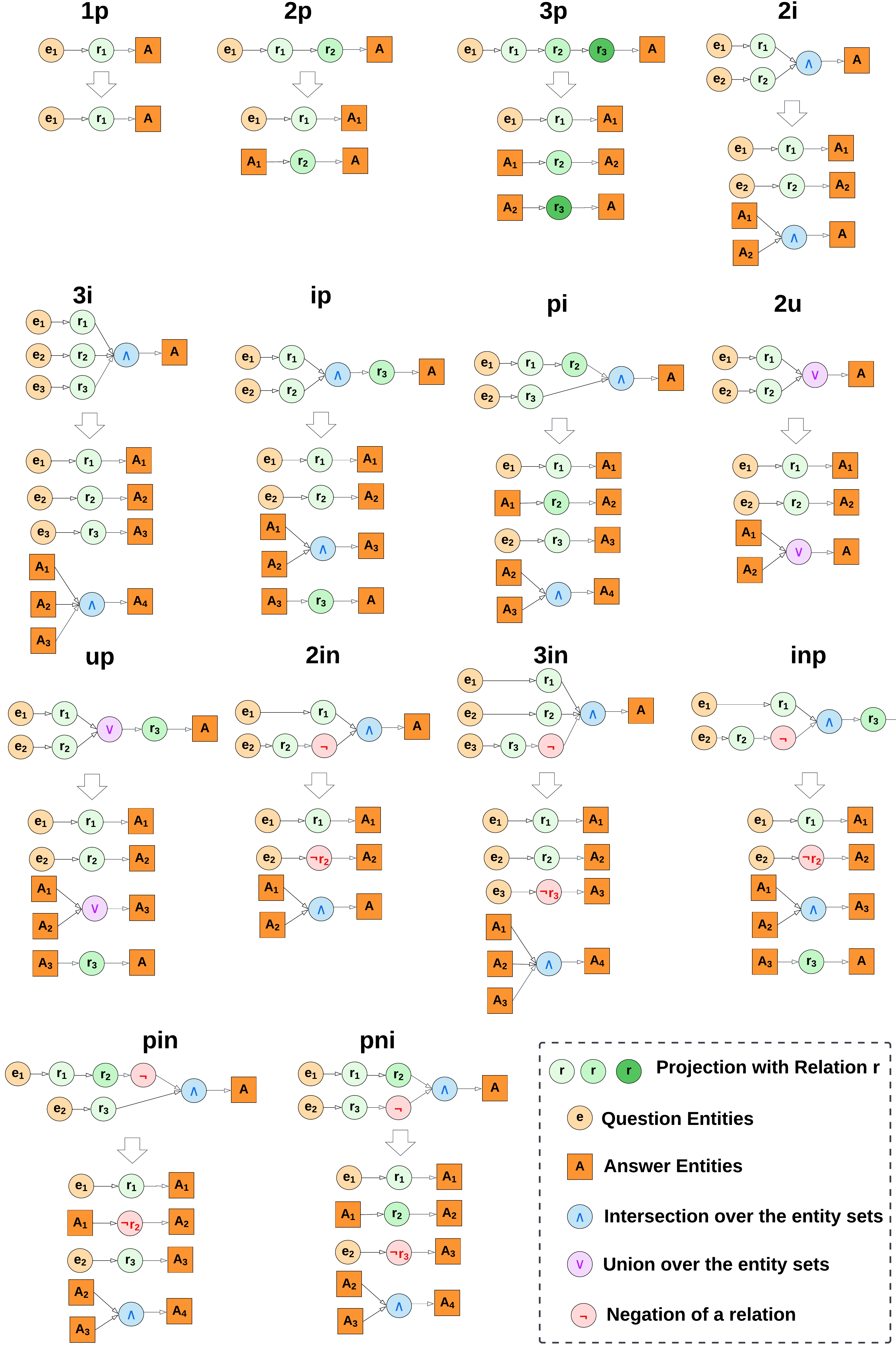
## Diagram Set: Logical Query Decomposition Patterns
### Overview
The image displays a collection of 14 distinct diagrams arranged in a grid pattern (4 rows, with the last row containing 2 diagrams and a legend). Each diagram is labeled with a short alphanumeric code (e.g., "1p", "2i", "pin") and illustrates a transformation from an initial logical query structure (top) to a decomposed or executed form (bottom), indicated by a large downward-pointing arrow. The diagrams use a consistent visual language of colored shapes and symbols to represent entities, relations, and logical operations, likely in the context of knowledge graph querying or semantic reasoning.
### Components/Axes
There are no traditional chart axes. The components are defined by a legend located in the bottom-right corner of the image.
**Legend (Bottom-Right):**
* **Green Circle (r):** "Projection with Relation r"
* **Orange Circle (e):** "Question Entities"
* **Orange Square (A):** "Answer Entities"
* **Blue Circle (Λ):** "Intersection over the entity sets"
* **Purple Circle (V):** "Union over the entity sets"
* **Pink Circle (¬):** "Negation of a relation"
**Diagram Labels (Top of each diagram):**
The 14 diagrams are labeled as follows, reading left-to-right, top-to-bottom:
1. **1p**
2. **2p**
3. **3p**
4. **2i**
5. **3i**
6. **ip**
7. **pi**
8. **2u**
9. **up**
10. **2in**
11. **3in**
12. **inp**
13. **pin**
14. **pni**
### Detailed Analysis
Each diagram follows a pattern: an initial query graph at the top transforms into a set of simpler, executable sub-queries at the bottom. The transformation is indicated by a large, white, downward-pointing arrow.
**Diagram-by-Diagram Breakdown:**
1. **1p (Single Projection):**
* **Initial:** `e1 -> r1 -> A`
* **Transformed:** `e1 -> r1 -> A1` (A single sub-query).
2. **2p (Two-hop Projection):**
* **Initial:** `e1 -> r1 -> r2 -> A`
* **Transformed:** Two sub-queries: `e1 -> r1 -> A1` and `A1 -> r2 -> A`.
3. **3p (Three-hop Projection):**
* **Initial:** `e1 -> r1 -> r2 -> r3 -> A`
* **Transformed:** Three sub-queries: `e1 -> r1 -> A1`, `A1 -> r2 -> A2`, `A2 -> r3 -> A`.
4. **2i (Two-entity Intersection):**
* **Initial:** Two paths (`e1 -> r1` and `e2 -> r2`) converge via an Intersection (Λ) to `A`.
* **Transformed:** Three sub-queries: `e1 -> r1 -> A1`, `e2 -> r2 -> A2`, and `A1, A2 -> Λ -> A`.
5. **3i (Three-entity Intersection):**
* **Initial:** Three paths (`e1 -> r1`, `e2 -> r2`, `e3 -> r3`) converge via an Intersection (Λ) to `A`.
* **Transformed:** Four sub-queries: `e1 -> r1 -> A1`, `e2 -> r2 -> A2`, `e3 -> r3 -> A3`, and `A1, A2, A3 -> Λ -> A4`.
6. **ip (Intersection then Projection):**
* **Initial:** Two paths (`e1 -> r1`, `e2 -> r2`) intersect (Λ), then project via `r3` to `A`.
* **Transformed:** Three sub-queries: `e1 -> r1 -> A1`, `e2 -> r2 -> A2`, `A1, A2 -> Λ -> A3`, and `A3 -> r3 -> A`.
7. **pi (Projection then Intersection):**
* **Initial:** Two paths: one is `e1 -> r1 -> r2`, the other is `e2 -> r3`. They intersect (Λ) to `A`.
* **Transformed:** Four sub-queries: `e1 -> r1 -> A1`, `A1 -> r2 -> A2`, `e2 -> r3 -> A3`, and `A2, A3 -> Λ -> A4`.
8. **2u (Two-entity Union):**
* **Initial:** Two paths (`e1 -> r1`, `e2 -> r2`) converge via a Union (V) to `A`.
* **Transformed:** Three sub-queries: `e1 -> r1 -> A1`, `e2 -> r2 -> A2`, and `A1, A2 -> V -> A`.
9. **up (Union then Projection):**
* **Initial:** Two paths (`e1 -> r1`, `e2 -> r2`) unite (V), then project via `r3` to `A`.
* **Transformed:** Three sub-queries: `e1 -> r1 -> A1`, `e2 -> r2 -> A2`, `A1, A2 -> V -> A3`, and `A3 -> r3 -> A`.
10. **2in (Two-entity Intersection with Negation):**
* **Initial:** Two paths: `e1 -> r1` and `e2 -> r2 -> ¬` (negation). They intersect (Λ) to `A`.
* **Transformed:** Three sub-queries: `e1 -> r1 -> A1`, `e2 -> ¬r2 -> A2`, and `A1, A2 -> Λ -> A`.
11. **3in (Three-entity Intersection with Negation):**
* **Initial:** Three paths: `e1 -> r1`, `e2 -> r2`, `e3 -> r3 -> ¬`. They intersect (Λ) to `A`.
* **Transformed:** Four sub-queries: `e1 -> r1 -> A1`, `e2 -> r2 -> A2`, `e3 -> ¬r3 -> A3`, and `A1, A2, A3 -> Λ -> A4`.
12. **inp (Intersection with Negation, then Projection):**
* **Initial:** Two paths (`e1 -> r1`, `e2 -> r2 -> ¬`) intersect (Λ), then project via `r3`.
* **Transformed:** Three sub-queries: `e1 -> r1 -> A1`, `e2 -> ¬r2 -> A2`, `A1, A2 -> Λ -> A3`, and `A3 -> r3 -> A`.
13. **pin (Projection, then Intersection with Negation):**
* **Initial:** Two paths: one is `e1 -> r1 -> r2 -> ¬`, the other is `e2 -> r3`. They intersect (Λ) to `A`.
* **Transformed:** Four sub-queries: `e1 -> r1 -> A1`, `A1 -> ¬r2 -> A2`, `e2 -> r3 -> A3`, and `A2, A3 -> Λ -> A4`.
14. **pni (Projection, Negation, then Intersection):**
* **Initial:** Two paths: one is `e1 -> r1 -> r2`, the other is `e2 -> r3 -> ¬`. They intersect (Λ) to `A`.
* **Transformed:** Four sub-queries: `e1 -> r1 -> A1`, `A1 -> r2 -> A2`, `e2 -> ¬r3 -> A3`, and `A2, A3 -> Λ -> A4`.
### Key Observations
* **Naming Convention:** The labels appear to be abbreviations describing the query structure: `p` for projection/hop, `i` for intersection, `u` for union, `n` for negation. The number indicates the count (e.g., `2i` = two-entity intersection).
* **Consistent Transformation:** Every diagram shows a complex query being decomposed into a sequence of simpler, likely executable, sub-queries. The final sub-query always produces the ultimate answer `A`.
* **Logical Operators:** The diagrams explicitly model core logical operations (Intersection Λ, Union V, Negation ¬) as nodes within the query graph.
* **Color Coding:** Strict adherence to the legend's color scheme is maintained throughout all diagrams for visual consistency.
### Interpretation
This image serves as a visual taxonomy or reference sheet for **logical query patterns over knowledge graphs or semantic networks**. It demonstrates how complex queries involving multi-hop paths, set operations (intersection, union), and negation can be systematically decomposed into a series of simpler, executable sub-queries.
The diagrams likely illustrate the operational semantics of a query language or reasoning system. The transformation from top to bottom represents the **query planning or rewriting phase**, where a high-level logical query is broken down into a sequence of basic graph traversal operations (projections) and set operations. This is a fundamental concept in database theory, semantic web technologies (like SPARQL), and neuro-symbolic AI, where symbolic queries are executed over structured knowledge bases.
The presence of negation (`¬`) is particularly significant, as it introduces the concept of "non-existence" or "exclusion" into the query logic, which is more complex to implement than positive projections. The set of diagrams provides a comprehensive catalog of common query shapes, serving as a valuable reference for understanding, designing, or implementing systems that perform logical reasoning over graph-structured data.
DECODING INTELLIGENCE...