## Diagram: RynnEC Bench
### Overview
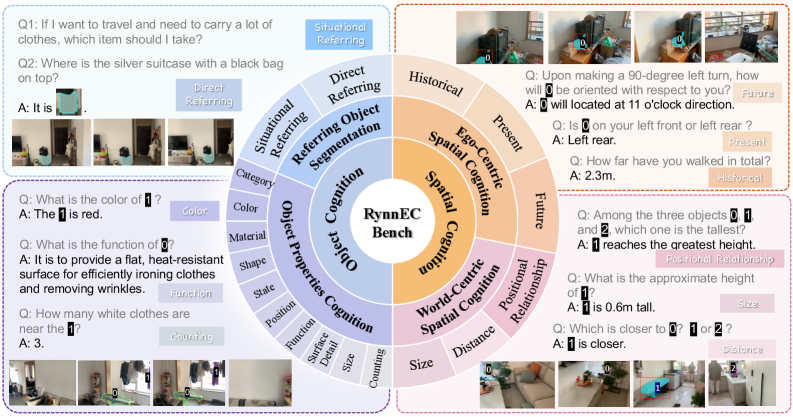
The image presents a diagram illustrating the RynnEC Bench, a framework for evaluating cognitive abilities related to object properties, spatial cognition, and referring object segmentation. The diagram is structured as a segmented circle, with each segment representing a different cognitive aspect. Each segment contains example questions and answers, along with associated images.
### Components/Axes
* **Central Text:** "RynnEC Bench"
* **Outer Ring Segments (Cognitive Aspects):**
* Referring Object Segmentation (Top)
* Object Properties Cognition (Left)
* Spatial Cognition (Right)
* **Sub-Segments within Object Properties Cognition (Left):**
* Category
* Color
* Material
* Shape
* State
* Position
* Function
* Surface Detail
* Size
* Counting
* **Sub-Segments within Spatial Cognition (Right):**
* Ego-Centric Spatial Cognition
* Present
* Future
* Historical
* World-Centric Spatial Cognition
* Positional Relationship
* Size
* Distance
* **Example Questions and Answers:** Each segment contains a question (Q) and an answer (A), along with associated images. These examples illustrate the type of cognitive task being evaluated.
### Detailed Analysis
**Referring Object Segmentation (Top):**
* **Sub-Categories:** Situational Referring, Direct Referring
* **Situational Referring Example:**
* Q1: If I want to travel and need to carry a lot of clothes, which item should I take?
* Q2: Where is the silver suitcase with a black bag on top?
* A: It is [image of a suitcase].
* **Direct Referring Example:**
* Images show a suitcase in a room from different angles.
**Object Properties Cognition (Left):**
* **Color Example:**
* Q: What is the color of 1?
* A: The 1 is red.
* Image shows an object labeled "1".
* **Function Example:**
* Q: What is the function of 0?
* A: It is to provide a flat, heat-resistant surface for efficiently ironing clothes and removing wrinkles.
* **Counting Example:**
* Q: How many white clothes are near the 1?
* A: 3.
* Images show clothes hanging in a room, with some labeled "1", "0", "2", "3".
**Spatial Cognition (Right):**
* **Ego-Centric Spatial Cognition Example:**
* Q: Upon making a 90-degree left turn, how will 0 be oriented with respect to you?
* A: 0 will located at 11 o'clock direction.
* Q: Is 0 on your left front or left rear?
* A: Left rear.
* Q: How far have you walked in total?
* A: 2.3m.
* Images show a room from different perspectives.
* **World-Centric Spatial Cognition Example:**
* Q: Among the three objects 0, 1, and 2, which one is the tallest?
* A: 1 reaches the greatest height.
* Q: What is the approximate height of 1?
* A: 1 is 0.6m tall.
* Q: Which is closer to 0, 1, or 2?
* A: 1 is closer.
* Images show objects in a room, labeled "0", "1", and "2".
### Key Observations
* The RynnEC Bench covers a range of cognitive abilities related to object recognition, spatial awareness, and language understanding.
* The examples provided are diverse and cover different scenarios.
* The use of images helps to ground the questions in a visual context.
### Interpretation
The RynnEC Bench appears to be a comprehensive framework for evaluating cognitive abilities in AI systems. By testing these abilities, researchers can gain insights into the strengths and weaknesses of different AI models and develop more robust and human-like AI systems. The framework's focus on object properties, spatial cognition, and referring object segmentation suggests that it is particularly well-suited for evaluating AI systems that interact with the physical world. The inclusion of both ego-centric and world-centric spatial cognition is important for evaluating AI systems that can understand and navigate their environment from both a first-person and third-person perspective.