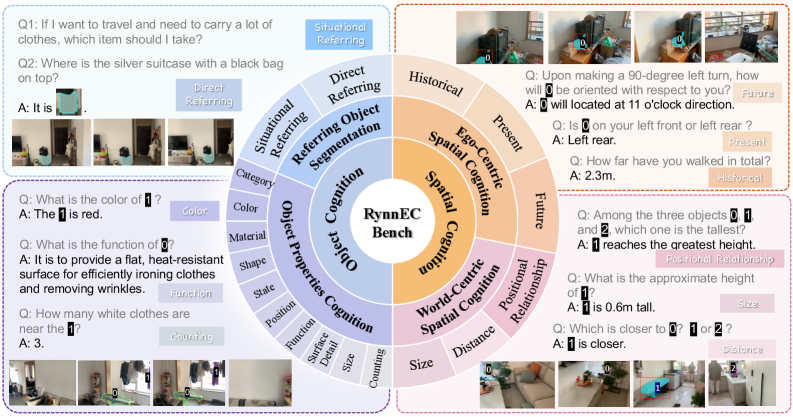
## Diagram: RynEC Bench Cognitive Framework
### Overview
The image depicts a circular diagram titled "RynEC Bench" with concentric layers representing cognitive domains. Four quadrants (Situational Referring, Direct Referring, Historical, Future) contain Q&A examples, while the central wheel categorizes cognitive aspects. The diagram integrates spatial, temporal, and object-centric cognition through color-coded sections.
### Components/Axes
1. **Central Wheel (Core Cognition)**:
- **Object Properties Cognition**: Color, Material, Shape, Size, Position, Surface, Detail, Counting
- **Spatial Cognition**: Distance, Positional Relationship, Size
- **World-Centric Cognition**: Function, State, Category
- **Ego-Centric Cognition**: Present, Future, Historical
- **Spatiotemporal Cognition**: Direct Referring, Situational Referring
2. **Quadrants (Cognitive Domains)**:
- **Situational Referring**: Q1 (travel clothes), Q3 (white clothes count)
- **Direct Referring**: Q2 (silver suitcase), Q4 (object function)
- **Historical**: Q5 (walking distance), Q7 (tallest object)
- **Future**: Q6 (orientation after turn), Q8 (object proximity)
3. **Legend**:
- Colors map to cognitive domains (e.g., blue for Situational Referring, orange for Historical). No explicit legend is visible, but color coding is implied by quadrant labels.
### Detailed Analysis
- **Quadrant Examples**:
- **Situational Referring**:
- Q1: "If I want to travel and need to carry a lot of clothes, which item should I take?" → A: "A. It is" (referring to a suitcase).
- Q3: "How many white clothes are near the [object]?" → A: "3."
- **Direct Referring**:
- Q2: "Where is the silver suitcase with a black bag on top?" → A: "A. It is" (direct reference to an object).
- Q4: "What is the function of [object]?" → A: "To provide a flat, heat-resistant surface for ironing clothes and removing wrinkles."
- **Historical**:
- Q5: "How far have you walked in total?" → A: "2.3m."
- Q7: "Among three objects, which is tallest?" → A: "A. reaches the greatest height."
- **Future**:
- Q6: "After a 90-degree left turn, where will [object] be?" → A: "11 o'clock direction."
- Q8: "Which is closer, [object 1] or [object 2]?" → A: "A. is closer."
- **Central Wheel Categories**:
- **Object Properties**: Color, Material, Shape, Size, Position, Surface, Detail, Counting
- **Spatial**: Distance, Positional Relationship, Size
- **World-Centric**: Function, State, Category
- **Ego-Centric**: Present, Future, Historical
- **Spatiotemporal**: Direct Referring, Situational Referring
### Key Observations
1. **Cognitive Integration**: The diagram emphasizes cross-domain cognition, linking object properties (e.g., color, size) with spatial reasoning (distance, positional relationships) and temporal context (historical vs. future).
2. **Practical Applications**: Q&A examples suggest use cases in robotics, navigation, or AI systems requiring multi-modal understanding (e.g., identifying objects, predicting movements).
3. **Ambiguity in Answers**: Some answers (e.g., "A. It is") lack specificity, implying the framework may prioritize contextual inference over explicit data.
### Interpretation
The RynEC Bench framework appears designed to evaluate or simulate cognitive processes in dynamic environments. By combining object properties, spatial reasoning, and temporal context, it likely supports tasks like:
- **Object Recognition**: Identifying items via color, shape, or function.
- **Navigation**: Predicting future positions or orientations.
- **Contextual Inference**: Linking historical data (e.g., walking distance) to current decisions.
The lack of explicit numerical data suggests the diagram is conceptual, focusing on cognitive architecture rather than empirical results. The emphasis on "Direct Referring" and "Situational Referring" implies applications in human-robot interaction or augmented reality systems requiring real-time environmental understanding.