## Diagram: Nurikabe Puzzle
### Overview
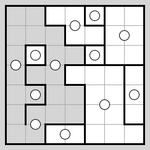
The image shows a completed Nurikabe puzzle on a grid. The grid is divided into regions, some of which are shaded gray (representing the "wall"), while others are white (representing the "islands"). Each white region contains a single circle with a number inside (not visible in this image), indicating the size of the island. The goal of Nurikabe is to shade cells to form a connected "wall" that does not create 2x2 blocks, and to ensure that the unshaded regions form islands of the correct size.
### Components/Axes
* **Grid:** A square grid, approximately 10x10 cells.
* **Wall (Gray Regions):** Shaded cells forming a connected network.
* **Islands (White Regions):** Unshaded regions, each containing a circle.
* **Circles:** Located within each island, representing the number of cells the island must contain. (The numbers themselves are not visible in this image.)
### Detailed Analysis
The image shows a solved Nurikabe puzzle. The gray "wall" is connected and does not form any 2x2 blocks. The white "islands" are separated by the wall. The circles within each island are not visible, so it is impossible to verify if the size of each island matches the number in the circle.
### Key Observations
* The gray wall is contiguous and covers a significant portion of the grid.
* The white islands are distinct and separated by the wall.
* The puzzle appears to be correctly solved, based on the rules of Nurikabe.
### Interpretation
The image demonstrates the solution to a Nurikabe puzzle. The puzzle involves logical deduction to determine which cells should be shaded to form a connected wall and which cells should remain unshaded to form islands of specific sizes. The solution adheres to the rules of Nurikabe, indicating a valid puzzle solution.