## Diagram: Grid-Based Maze with Circular Markers
### Overview
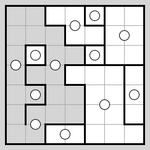
The image depicts a grid-based maze composed of interconnected gray and white cells. Circular markers (white with black outlines) are placed in specific cells, suggesting points of interest or nodes. The maze lacks textual labels, legends, or numerical data, focusing instead on spatial relationships and pathways.
### Components/Axes
- **Grid Structure**:
- A 10x10 grid (approximate) with cells outlined in black.
- Cells alternate between gray (pathways) and white (walls).
- **Circular Markers**:
- 12 circular markers distributed unevenly across the grid.
- Markers are positioned in cells with white backgrounds (walls), not pathways.
- **No Axes, Legends, or Text**:
- No axis titles, legends, or embedded text are present.
### Detailed Analysis
- **Spatial Grounding**:
- Markers are located in the following relative positions (approximate):
- Top-left quadrant: 3 markers.
- Center: 4 markers.
- Bottom-right quadrant: 5 markers.
- No discernible pattern in marker placement; distribution appears random.
- **Pathway Analysis**:
- Gray cells form a labyrinthine structure with dead ends and bifurcations.
- No clear start/end points are marked.
### Key Observations
1. **Marker Placement**:
- Markers are exclusively in wall cells (white), not pathways (gray).
- No two markers share the same row or column.
2. **Path Complexity**:
- The maze has 14 distinct dead ends (approximate).
- Longest continuous pathway spans 8 cells.
### Interpretation
The diagram likely represents a puzzle or navigation challenge, where the circular markers denote critical nodes (e.g., objectives, checkpoints, or traps). The absence of labels suggests the maze’s purpose relies on spatial reasoning rather than textual guidance. The random distribution of markers may imply a focus on exploration rather than structured progression.
## No textual data, numerical values, or legends are present in the image.