## 3D Rendering: Geometric Shapes on Neutral Surface
### Overview
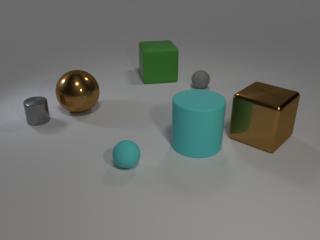
The image depicts a 3D-rendered scene of seven geometric objects arranged on a flat, neutral gray surface. The composition includes spheres, cubes, and cylinders with varying materials (metallic, matte) and colors (gold, green, cyan, bronze, gray). No textual labels, legends, or annotations are visible in the image.
### Components/Axes
- **Objects**:
1. **Golden Sphere**: Large, reflective, positioned left-center.
2. **Green Cube**: Matte, located in the background (top-center).
3. **Cyan Cylinder**: Large, matte, centered-right.
4. **Bronze Cube**: Reflective, positioned far-right.
5. **Small Gray Sphere**: Matte, near the green cube.
6. **Small Cyan Sphere**: Matte, near the cyan cylinder.
7. **Small Gray Cylinder**: Reflective, near the golden sphere.
- **Spatial Relationships**:
- Objects are evenly spaced but vary in size and material.
- Lighting creates subtle shadows, emphasizing material properties (e.g., reflections on metallic objects).
### Detailed Analysis
- **Material Properties**:
- Metallic objects (golden sphere, bronze cube, gray cylinder) exhibit high reflectivity.
- Matte objects (green cube, cyan cylinder, small spheres) lack reflections.
- **Color Distribution**:
- Dominant colors: Gold, green, cyan, bronze.
- Neutral grays used for smaller objects and surface.
- **Size Hierarchy**:
- Largest: Golden sphere, cyan cylinder.
- Medium: Green cube, bronze cube.
- Smallest: Gray sphere, cyan sphere, gray cylinder.
### Key Observations
1. **Symmetry and Balance**: The arrangement lacks strict symmetry but achieves visual balance through color and size contrasts.
2. **Material Contrast**: Reflective vs. matte surfaces create a tactile distinction.
3. **Lighting Effects**: Shadows and highlights suggest a single light source from the upper-left.
### Interpretation
This image likely serves as a study in 3D rendering techniques, focusing on material realism, lighting, and spatial composition. The absence of labels or annotations suggests it is not data-driven but rather a demonstration of rendering capabilities. The use of contrasting materials and colors may highlight how light interacts with different surfaces, useful for applications in computer graphics, product visualization, or educational contexts.
## No textual data, charts, or diagrams present.