## Diagram: Linguistic Dependency/Attention Visualization
### Overview
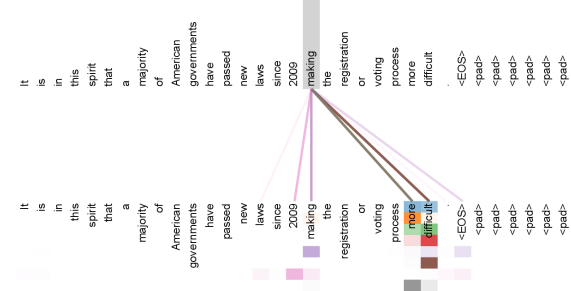
The image displays a visualization of linguistic relationships or attention weights between words in a sentence. It consists of two horizontal rows of text. The top row contains a complete sentence, while the bottom row repeats the sentence with colored, numbered blocks overlaid on specific words. Lines connect a single word in the top row to multiple words in the bottom row, with the line colors corresponding to the colored blocks. This is characteristic of a dependency parse tree or an attention mechanism visualization from a natural language processing model.
### Components/Axes
* **Primary Text (Top Row):** A single English sentence: "It is in this spirit that a majority of American governments have passed new laws since 2009 making the registration or voting process more difficult . <EOS> <pad> <pad> <pad> <pad> <pad>"
* **Secondary Text (Bottom Row):** The same sentence repeated: "It is in this spirit that a majority of American governments have passed new laws since 2009 making the registration or voting process more difficult . <EOS> <pad> <pad> <pad> <pad> <pad>"
* **Connecting Lines:** Multiple lines originate from the word "**making**" in the top row and connect to various words in the bottom row. The lines are colored (purple, brown, green, red, blue).
* **Colored Blocks & Legend:** Small, colored rectangular blocks with numerical values are placed on or near specific words in the bottom row. A legend in the bottom-right corner maps colors to numerical values:
* **Blue:** 0.2
* **Green:** 0.3
* **Red:** 0.1
* **Brown:** 0.2
* **Purple:** 0.2
* **Spatial Grounding:** The legend is positioned in the bottom-right quadrant of the image. The connecting lines fan out downwards and to the right from the source word "making" (top row, center-right) to the target words in the bottom row.
### Detailed Analysis
**Word-by-Word Mapping & Connection Analysis:**
The diagram isolates the verb "**making**" as the central node. Lines connect it to the following words in the bottom row, with associated weights from the legend:
1. **"registration"**: Connected by a **green** line. A **green block** with the value **0.3** is placed on this word.
2. **"or"**: Connected by a **red** line. A **red block** with the value **0.1** is placed on this word.
3. **"voting"**: Connected by a **blue** line. A **blue block** with the value **0.2** is placed on this word.
4. **"process"**: Connected by a **brown** line. A **brown block** with the value **0.2** is placed on this word.
5. **"more"**: Connected by a **purple** line. A **purple block** with the value **0.2** is placed on this word.
6. **"difficult"**: Connected by a **purple** line. A **purple block** with the value **0.2** is placed on this word.
**Trend Verification:** The visual trend shows a focused distribution of connection weights from "making" to the noun phrase "registration or voting process" and its modifiers "more difficult." The highest weight (0.3) is on the noun "registration," suggesting it is the most strongly linked object of the verb "making" in this context.
**Text Transcription (Complete):**
The full sentence, including special tokens, is:
`It is in this spirit that a majority of American governments have passed new laws since 2009 making the registration or voting process more difficult . <EOS> <pad> <pad> <pad> <pad> <pad>`
* `<EOS>`: Likely denotes "End Of Sequence."
* `<pad>`: Denotes padding tokens, used to fill sequence length in machine learning models.
### Key Observations
1. **Focused Attention:** The visualization explicitly shows that the model's attention or the syntactic dependency for the verb "making" is concentrated on the subsequent noun phrase and its modifiers, not on the subject or earlier parts of the sentence.
2. **Weight Distribution:** The weights are not evenly distributed. "Registration" (0.3) carries 50% more weight than "voting," "process," "more," or "difficult" (each 0.2), and three times the weight of "or" (0.1).
3. **Structural Tokens:** The presence of `<EOS>` and `<pad>` tokens confirms this is a visualization from a computational model's processing pipeline, not a purely linguistic diagram.
### Interpretation
This diagram is a technical visualization, likely from a neural network model (e.g., a Transformer-based model) performing a task like dependency parsing, semantic role labeling, or machine translation. It demonstrates how the model assigns importance or establishes a syntactic link between the verb "making" and its complex object.
**What the data suggests:** The model identifies "making" as the pivotal action that connects the main clause ("governments have passed new laws") to the purpose or result clause ("making the registration... more difficult"). The higher weight on "registration" versus "voting" could imply the model interprets the laws as primarily targeting the registration process, with voting being a secondary, coordinated element. The low weight on the conjunction "or" is logical, as it is a functional word with less semantic content.
**Why it matters:** Such visualizations are crucial for model interpretability. They allow researchers to "see inside" the model's decision-making process, verifying that it is focusing on linguistically plausible relationships. This builds trust in the model's outputs and helps diagnose errors if the attention weights were assigned to irrelevant words.
**Notable Anomaly:** The connection to the word "more" (an adverb) is interesting. It suggests the model is linking "making" not just to the head nouns ("registration," "voting process") but also to the comparative modifier "more," which is essential for understanding the *nature* of the change being described (making things *more* difficult). This indicates a nuanced capture of the phrase's meaning.