## Diagram: LLM Workflow for Historical Query
### Overview
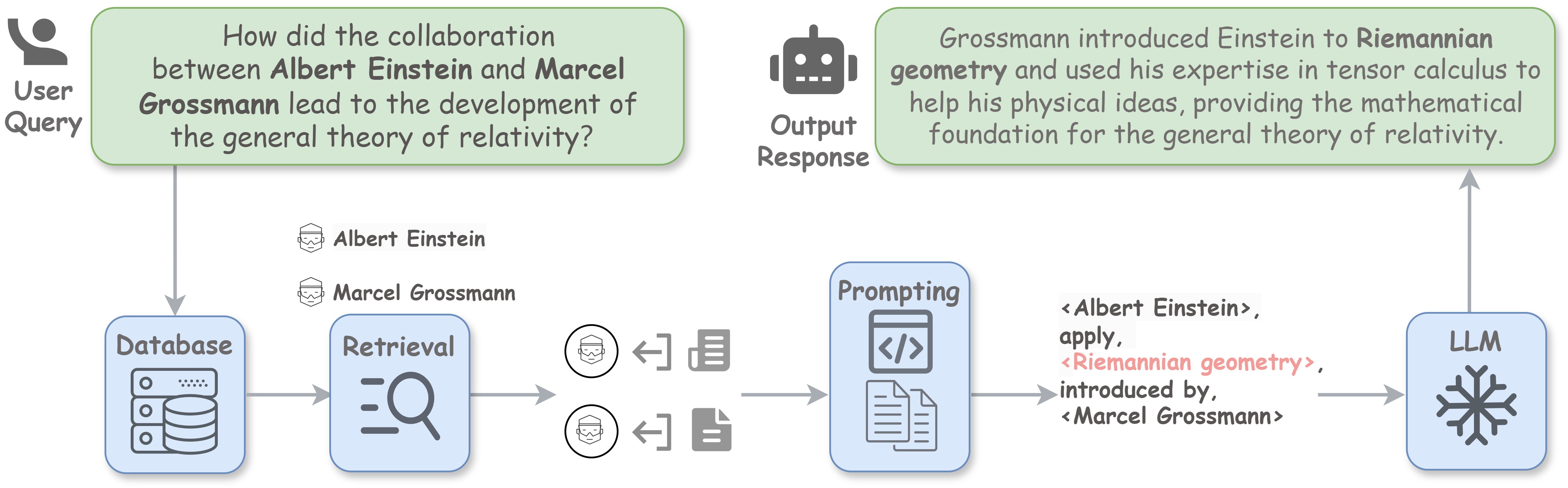
The image depicts a diagram illustrating the workflow of a Large Language Model (LLM) in answering a historical query about the collaboration between Albert Einstein and Marcel Grossmann. The diagram outlines the steps from user query to the final output response, including database retrieval, prompting, and LLM processing.
### Components/Axes
* **User Query:** Located at the top-left, represented by a person icon and the text "User Query". The query itself is contained within a green rounded rectangle: "How did the collaboration between Albert Einstein and Marcel Grossmann lead to the development of the general theory of relativity?"
* **Database:** Located at the bottom-left, represented by a database icon and the text "Database".
* **Retrieval:** Located to the right of the database, represented by a magnifying glass icon and the text "Retrieval". Above the Retrieval box are two icons of Albert Einstein and Marcel Grossman.
* **Prompting:** Located in the center-right, represented by a code icon and document icons, and the text "Prompting". The prompt itself is: "<Albert Einstein>, apply, <Riemannian geometry>, introduced by, <Marcel Grossmann>". The text "Riemannian geometry" is in pink.
* **LLM:** Located at the bottom-right, represented by a snowflake icon and the text "LLM".
* **Output Response:** Located at the top-right, represented by a robot icon and the text "Output Response". The response itself is contained within a green rounded rectangle: "Grossmann introduced Einstein to Riemannian geometry and used his expertise in tensor calculus to help his physical ideas, providing the mathematical foundation for the general theory of relativity."
* **Flow Arrows:** Arrows indicate the flow of information from the user query to the database, then to retrieval, prompting, LLM, and finally to the output response.
### Detailed Analysis or ### Content Details
1. **User Query:** The user initiates the process with a question about the collaboration between Albert Einstein and Marcel Grossmann and its impact on the development of the general theory of relativity.
2. **Database Retrieval:** The query triggers a retrieval process from a database. The database icon suggests a structured data storage system. The icons of Albert Einstein and Marcel Grossman are above the Retrieval box.
3. **Prompting:** The retrieved information is used to create a prompt for the LLM. The prompt includes specific entities like "Albert Einstein" and "Riemannian geometry," suggesting a structured approach to guide the LLM's response.
4. **LLM Processing:** The LLM processes the prompt and generates a response. The snowflake icon might symbolize the complex computations involved in LLM processing.
5. **Output Response:** The LLM provides a detailed response explaining how Grossmann introduced Einstein to Riemannian geometry and used his expertise in tensor calculus, which helped Einstein develop his physical ideas and provided the mathematical foundation for the general theory of relativity.
### Key Observations
* The diagram highlights the structured approach to querying and utilizing an LLM for historical information retrieval.
* The use of specific entities in the prompt suggests a knowledge-graph-based approach or a focus on named entity recognition.
* The LLM's response emphasizes the contributions of both Einstein and Grossmann, providing a balanced perspective.
### Interpretation
The diagram illustrates a knowledge retrieval system leveraging an LLM to answer a complex historical question. The system uses a structured approach, retrieving relevant information from a database, formulating a prompt with specific entities, and then using the LLM to generate a comprehensive response. The diagram demonstrates how LLMs can be used to access and synthesize historical information, providing valuable insights into the contributions of different individuals and the development of scientific theories. The system appears to be designed to provide accurate and contextually relevant answers by grounding the LLM's response in structured data and specific prompts.