## Flowchart: Collaboration Process for General Theory of Relativity
### Overview
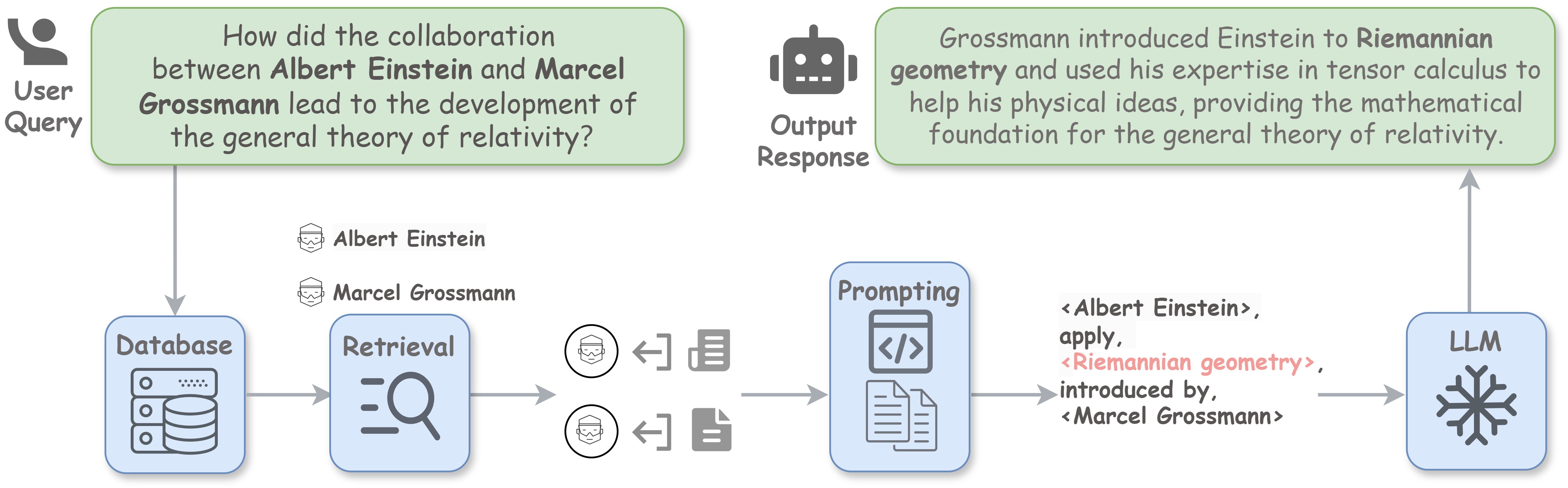
This flowchart illustrates the process of answering a user query about the collaboration between Albert Einstein and Marcel Grossmann in developing the general theory of relativity. It shows how a language model (LLM) retrieves historical information, processes it through prompting, and generates a response explaining their scientific partnership.
### Components/Axes
1. **User Query** (Top-left):
- Text: "How did the collaboration between Albert Einstein and Marcel Grossmann lead to the development of the general theory of relativity?"
- Icon: Silhouette of a person raising a hand
2. **Database** (Bottom-left):
- Icon: Stacked disks representing data storage
- Label: "Database"
3. **Retrieval** (Center-left):
- Icon: Magnifying glass over text lines
- Label: "Retrieval"
- Outputs: Documents labeled "Albert Einstein" and "Marcel Grossmann"
4. **Prompting** (Center-right):
- Icon: Code brackets and document pages
- Label: "Prompting"
- Text: "<Albert Einstein>, apply, <Riemannian geometry>, introduced by, <Marcel Grossmann>"
5. **LLM** (Bottom-right):
- Icon: Snowflake symbolizing neural network
- Label: "LLM"
6. **Output Response** (Top-right):
- Text: "Grossmann introduced Einstein to Riemannian geometry and used his expertise in tensor calculus to help his physical ideas, providing the mathematical foundation for the general theory of relativity."
- Icon: Robot head
### Detailed Analysis
- **Flow Direction**: Left-to-right progression from query to response
- **Key Connections**:
- User query → Database → Retrieval (scientist documents) → Prompting → LLM → Output response
- **Textual Elements**:
- All labels and text blocks are explicitly annotated
- Scientist names appear in both retrieval documents and prompting structure
### Key Observations
1. The process emphasizes historical accuracy through structured information retrieval
2. The prompting stage explicitly connects Einstein's physical concepts with Grossmann's mathematical contributions
3. The LLM synthesizes retrieved information into a coherent explanation
4. No numerical data or quantitative elements present
### Interpretation
This diagram demonstrates how AI systems can:
1. Access historical scientific records
2. Contextually link interdisciplinary contributions (physics + mathematics)
3. Generate explanations that highlight collaborative scientific processes
The flowchart reveals that Grossmann's expertise in Riemannian geometry and tensor calculus provided the mathematical framework Einstein needed to formalize his physical theories, illustrating how cross-disciplinary collaboration drives scientific breakthroughs.