\n
## Document: Observation & Indication Worksheet
### Overview
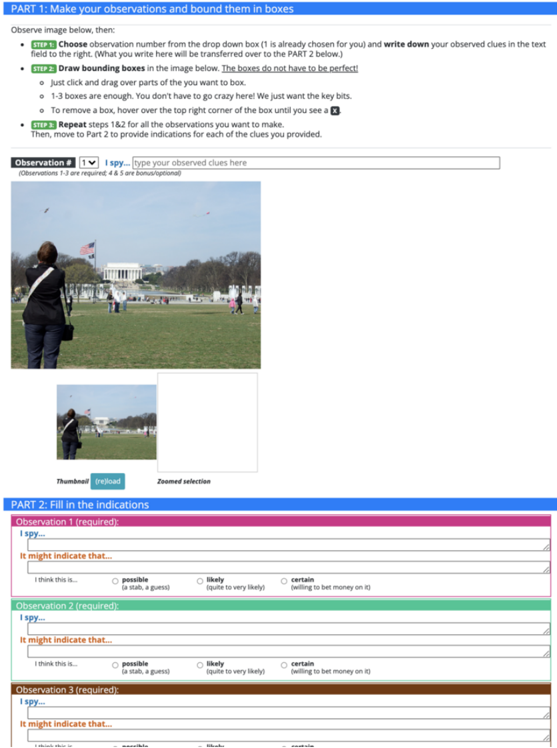
The image presents a worksheet designed for observational analysis and indication assessment. The worksheet is divided into two parts: Part 1 focuses on making observations and bounding them in boxes on an image, and Part 2 focuses on filling in indications based on those observations. The image features a photograph of a person walking with a dog in a park-like setting.
### Components/Axes
The worksheet is structured with the following components:
* **Part 1 Header:** "PART 1: Make your observations and bound them in boxes"
* **Part 1 Instructions:** A numbered list of instructions for making observations and drawing bounding boxes.
* **Part 1 Observation Selection:** A dropdown menu labeled "Observation #1" with a text field for typing observed clues. The text "(Observations # 3 & 4 & 5 are bonus/optional)" is present.
* **Part 1 Image:** A photograph of a person walking a dog. Buttons labeled "Thumbnail", "In-load", and "Zoomed selection" are present below the image.
* **Part 2 Header:** "PART 2: Fill in the indications"
* **Part 2 Observation Sections:** Three sections labeled "Observation 1 (required)", "Observation 2 (required)", and "Observation 3 (required)". Each section includes a text field labeled "I spy..." and a text field labeled "It might indicate that...".
* **Part 2 Indication Options:** Each observation section provides three radio button options: "possible (a stab, a guess)", "likely (quite to very likely)", and "certain (willing to bet money on it)".
### Detailed Analysis or Content Details
**Part 1 - Image Description:**
The photograph depicts a person, appearing to be female, walking a dog on a leash. The person is wearing a dark jacket, dark pants, and a hat. The dog is a medium-sized breed, possibly a terrier mix, and is also dark in color. The background shows trees with bare branches, suggesting it is late fall or winter. The ground is covered with leaves and some snow. The scene appears to be a park or a similar outdoor area.
**Part 1 - Instructions (Transcribed):**
1. Choose observation number from the drop down box (1 is already chosen for you) and write down your observed clues in the text field to the right. (What you write here will be transferred over to the PART 2 below.)
2. Draw bounding boxes in the image below. The boxes do not have to be perfect!
3. Just click and drag over parts of the you want to box.
4. 1-3 boxes are enough. You don't have to go crazy here! We just want the key bits.
5. To remove a box, hover over the top right corner of the box until you see a X.
6. Repeat steps 1 & 2 for all the observations you want to make. Then, move to Part 2 to provide indications for each of the clues you provided.
**Part 2 - Observation Sections:**
Each observation section has the following structure:
* **I spy...:** [Text field for observation]
* **It might indicate that...:** [Text field for indication]
* **Indication Options:**
* Possible (a stab, a guess)
* Likely (quite to very likely)
* Certain (willing to bet money on it)
The text fields are currently empty.
### Key Observations
The worksheet is designed to encourage detailed observation and reasoned inference. The inclusion of a "certain" option suggests a desire for high-confidence assessments. The bonus/optional nature of observations 4 and 5 indicates a focus on core observations.
### Interpretation
The worksheet is a tool for developing observational skills and analytical thinking. It prompts the user to move from simply noticing details (Part 1) to forming hypotheses about their meaning (Part 2). The graduated scale of confidence (possible, likely, certain) encourages careful consideration of the evidence supporting each interpretation. The image itself provides a relatively simple scene, likely chosen to allow the user to focus on the process of observation and indication rather than the complexity of the subject matter. The worksheet is likely used in an educational or training context, potentially in fields such as intelligence analysis, security, or scientific investigation. The instructions emphasize that the bounding boxes do not need to be perfect, suggesting that the focus is on identifying key elements rather than precise delineation.