## Diagram: Entity Relationship Diagram
### Overview
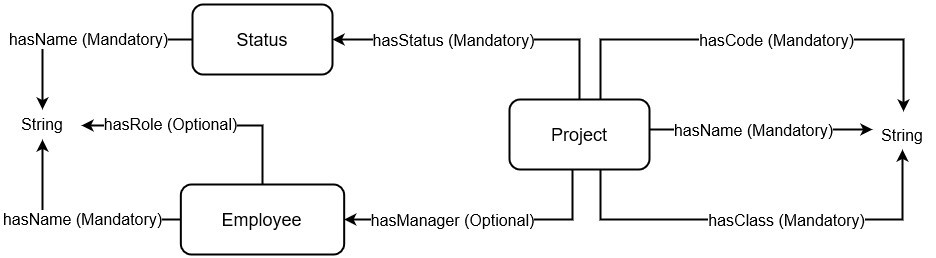
The image is an entity-relationship diagram illustrating the relationships between "Status", "Employee", "Project", and "String" entities. The diagram specifies the type of relationship (e.g., "hasName", "hasStatus") and whether the relationship is mandatory or optional.
### Components/Axes
* **Entities:**
* Status (Rounded rectangle)
* Employee (Rounded rectangle)
* Project (Rounded rectangle)
* String (Text label)
* **Relationships:**
* hasName (Mandatory)
* hasStatus (Mandatory)
* hasRole (Optional)
* hasManager (Optional)
* hasCode (Mandatory)
* hasClass (Mandatory)
### Detailed Analysis
* **Status:**
* "Status" has a mandatory "hasName" relationship to "String".
* "Status" has a mandatory "hasStatus" relationship to "Project".
* **Employee:**
* "Employee" has a mandatory "hasName" relationship to "String".
* "Employee" has an optional "hasRole" relationship to "String".
* "Employee" has an optional "hasManager" relationship to "Project".
* **Project:**
* "Project" has a mandatory "hasCode" relationship to "String".
* "Project" has a mandatory "hasName" relationship to "String".
* "Project" has a mandatory "hasClass" relationship to "String".
* "Project" has a mandatory "hasStatus" relationship to "Status".
* "Project" has an optional "hasManager" relationship to "Employee".
* **String:**
* "String" is connected to "Status", "Employee", and "Project" via the relationships mentioned above.
### Key Observations
* The "hasName" relationship is consistently mandatory for "Status" and "Employee".
* The "hasStatus", "hasCode", "hasName", and "hasClass" relationships are mandatory for "Project".
* The "hasRole" and "hasManager" relationships are optional.
* The diagram uses arrows to indicate the direction of the relationship.
### Interpretation
The diagram represents a data model where "Status", "Employee", and "Project" are key entities. Each entity has a name, which is a mandatory attribute represented as a "String". "Project" has additional mandatory attributes like "Code" and "Class". The "hasStatus" relationship indicates that a project must have a status. The "hasRole" and "hasManager" relationships suggest that employees can have roles and can be managers of projects, but these are not required. The diagram provides a high-level overview of the data structure and relationships within a system, likely related to project management or human resources.